
14 Fruit Animals Art Ideas That Will Transform Your Creative Practice
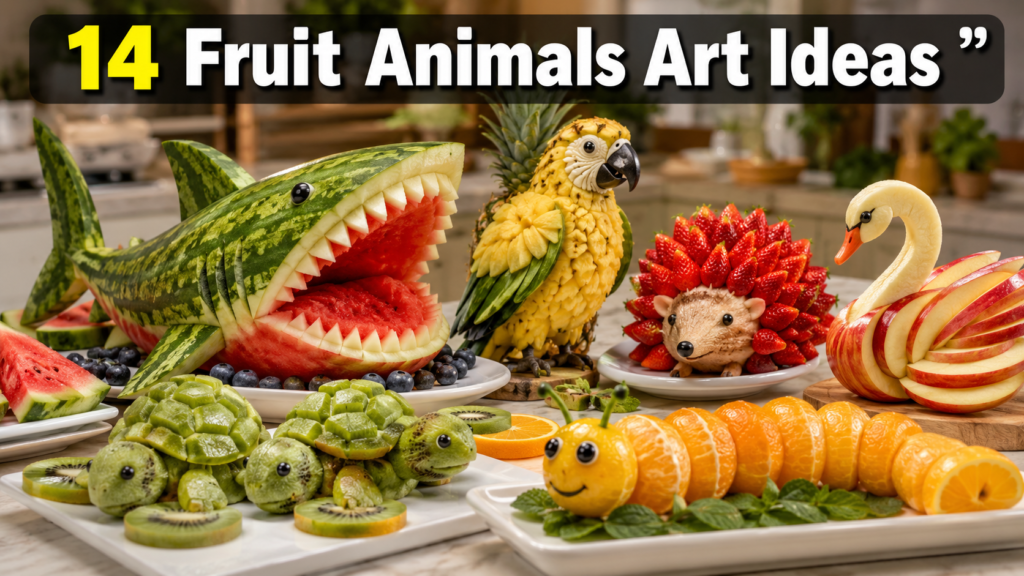
I ruined a watermelon once. A beautiful, perfectly ripe watermelon. I had this grand vision of a carved flamingo rising from the green rind, wings spread, beak pointed skyward. Three hours later, I had something that looked more like a deflated balloon animal than a bird. The kitchen smelled incredible. My ego did not.
That failure taught me more about fruit animals art than any tutorial ever has.
Here’s the thing nobody talks about: fruit animals art is one of those creative niches that looks effortless when done well and absolutely punishing when you rush it. The gap between a Pinterest-worthy strawberry hedgehog and a sad, brown-edged disaster is not talent. It’s knowledge. Specifically, it’s knowing which fruits hold structure, which cutting angles work for which animal shapes, and how long you have before oxidation ruins everything.
This guide covers 14 fruit animals art ideas across skill levels, from genuinely beginner-friendly (no, seriously beginner-friendly) to the kind of projects that belong in professional food styling portfolios. You will find real material comparisons, honest time estimates, and the mistakes I’ve watched people make over and over.
Ready to stop wasting fruit and start making art?
What Makes Fruit Animals Art Different From Regular Food Art?
Fruit animals art occupies a unique creative space because it demands both artistic instinct and food science knowledge. The best practitioners treat their fruit the way sculptors treat marble: you learn what the material wants to do, then guide it.
Most people approach fruit carving or fruit assembly the wrong way. They see a finished piece on social media, grab a knife and some fruit, and start cutting with no plan. That approach works maybe 15% of the time. The other 85% ends in oxidized edges, structural collapse, and wasted produce.
The fundamental difference between fruit animals art and other food art forms is the time constraint. Oil paints dry slowly. Clay stays workable for hours. A sliced apple starts browning in roughly seven to twelve minutes at room temperature, depending on the variety. Granny Smith holds longer than Fuji. That’s not trivia. That’s the difference between finishing your piece and throwing it in the compost.
Here’s what genuinely surprised me when I started taking this seriously: the fruit you choose matters more than the cutting technique. I’ve watched skilled artists struggle with overly ripe mangoes while beginners produced clean, crisp work using firm, slightly underripe pears. The fruit is your canvas. Treating it like an afterthought is the single most common mistake in this art form.
The other dimension people ignore is scale. A strawberry hedgehog uses the fruit’s natural form. A watermelon dolphin requires understanding negative space and structural engineering. These are fundamentally different creative challenges, and conflating them is why so many people give up after their first ambitious project.
Which Fruits Work Best for Animal Art Projects?
The best fruits for animal art are firm-fleshed, low-oxidation varieties with natural color contrast. Watermelons, pineapples, apples, pears, and citrus fruits lead the field. Soft fruits like ripe peaches or bananas are for specific effects only.
Let me give you the honest breakdown from working with dozens of fruit types.
Watermelon is the king of large-scale fruit animal art. The green-to-white-to-red gradient gives you three distinct visual layers to work with, the flesh holds structural cuts well, and a ripe watermelon gives you enough volume for genuinely ambitious forms. Dolphins, turtles, and sharks are natural fits because the oval body shape maps cleanly onto a standard watermelon.
Pineapples are the most underrated fruit in this space. The natural texture of the exterior skin creates instant visual interest, the yellow interior provides warm contrast, and the crown can be preserved and repositioned as decorative foliage. I’ve seen pineapple parrots that stopped an entire room. The challenge is the fibrous core, which resists fine detail work.
Apples and pears occupy the sweet spot for intermediate artists. They’re available year-round, inexpensive enough to practice with, and their flesh holds carved details with impressive precision. A firm Bosc pear becomes a convincing penguin body. A red apple with strategic cuts transforms into a swan. Brush the cut surfaces with lemon juice and you double your working time.
Citrus fruits, particularly navel oranges and grapefruits, excel at medium-scale projects because the pith layer between rind and flesh gives you a natural cutting depth to work within. Citrus caterpillars and snails are gateway projects that build the muscle memory for more complex work.
The fruits to avoid for structural projects: overripe mangoes, ripe bananas (save these for stamping projects), soft pears, and anything with significant bruising. Bruised flesh collapses under pressure and won’t hold carved lines.
The 14 Best Fruit Animals Art Ideas, Ranked by Difficulty
1. Strawberry Hedgehog (Beginner, 10-15 minutes)
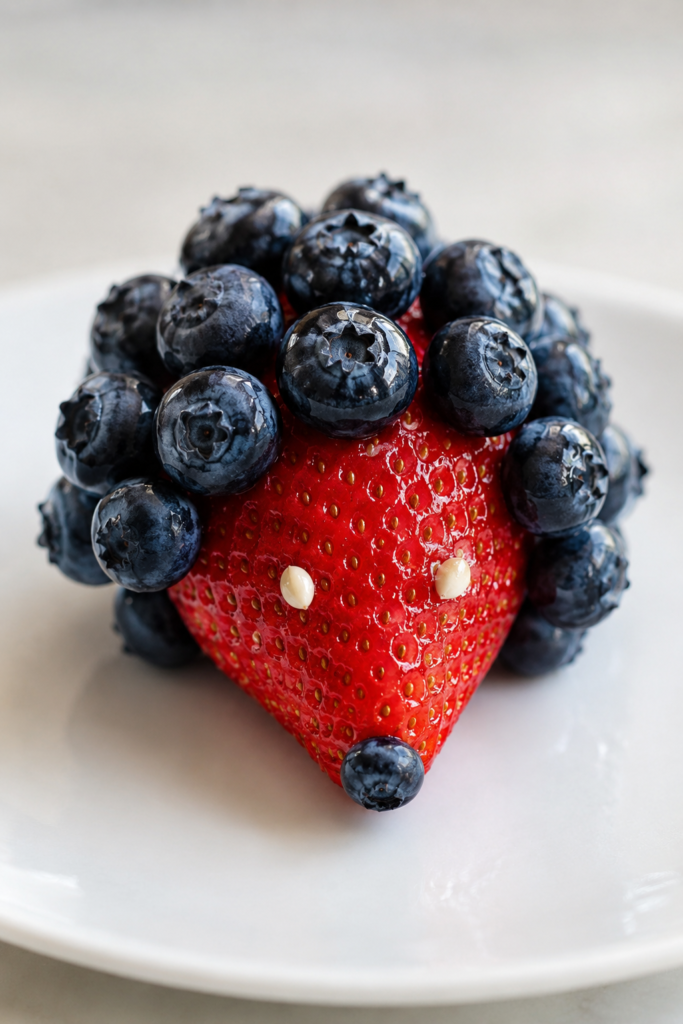
This is the project I recommend to every single person who asks where to start. A firm strawberry, a toothpick, and some blueberries is all you need. The hedgehog’s round body maps perfectly onto a strawberry’s natural shape, and there’s zero cutting required.
Place your strawberry point-down on a small plate. Use a toothpick to create a pilot hole, then push blueberries in rows across the rounded back. A small chocolate chip or another blueberry becomes the nose at the point tip. Two tiny white sesame seeds pressed into the flesh become eyes.
The trick that makes the difference: angle your blueberry rows slightly backward toward the tail. This creates the illusion of raised spines rather than a flat, uniform surface. It takes thirty additional seconds and the visual effect is significant.
I’ve used this project with kids as young as five and adults who claimed they had “zero artistic ability.” Success rate is close to 100% when using firm strawberries. This is genuinely the best entry point in all of fruit animals art.
2. Apple Swan (Beginner-Intermediate, 20-30 minutes)
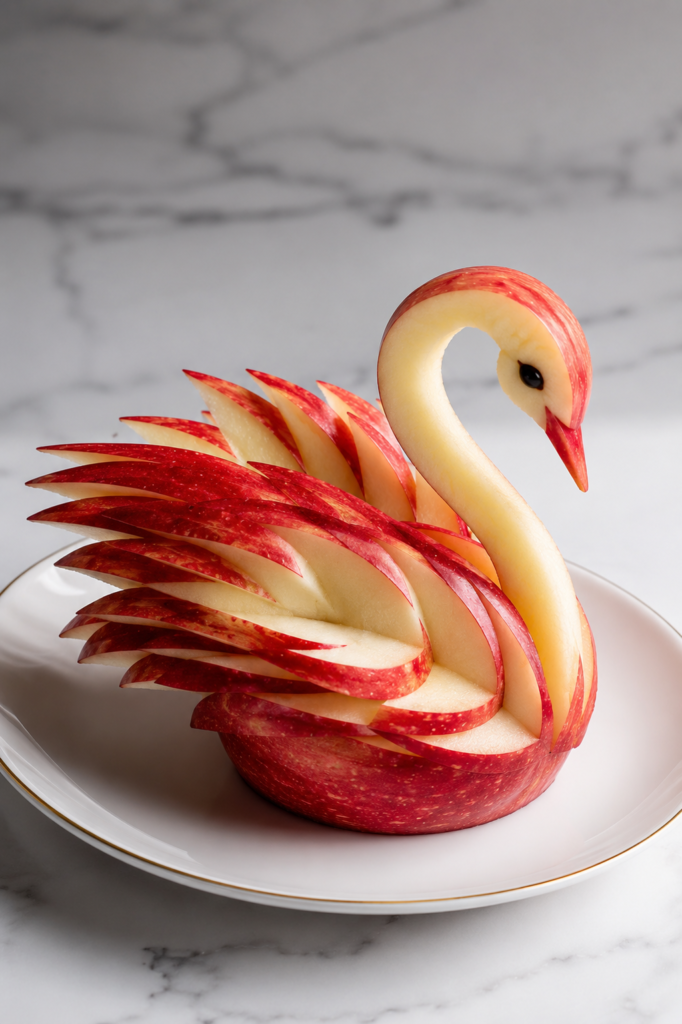
The apple swan is a classic for a reason. It teaches the core V-cut technique used in dozens of other fruit animals art projects, and the result genuinely looks impressive to people who haven’t seen it before.
Choose a large, firm apple. Core it without cutting through. Starting from the midpoint, make symmetrical V-shaped cuts across both halves of the apple, creating graduated fan shapes. The cuts should get progressively smaller as they approach the center. Fan the cut sections outward. Use a small piece of apple or a grape for the swan’s head, attach with a toothpick, and curve a thin apple slice into an S-shaped neck.
The most common mistake here is cutting the V shapes too wide. Narrow, precise cuts create defined “feathers.” Wide cuts create mush. Take your time on the first cut. The rest follow naturally.
3. Watermelon Turtle (Intermediate, 45-60 minutes)
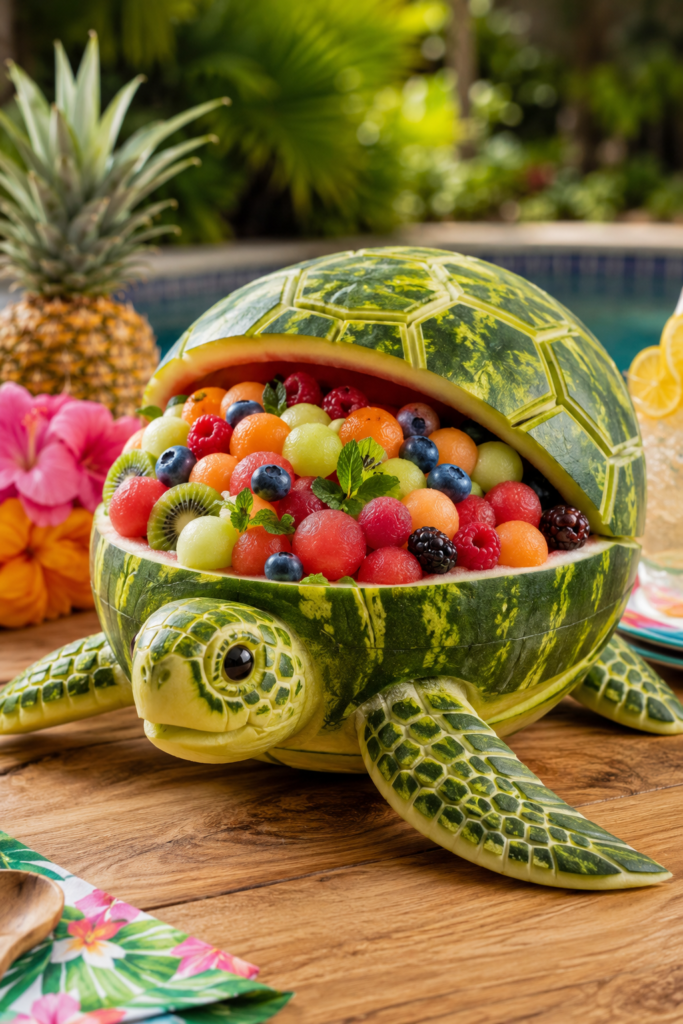
Here’s where things get genuinely interesting. The watermelon turtle uses the fruit’s entire structure: the rind becomes the shell, the carved flesh creates the body details, and the natural color contrast does most of the visual work for you.
Start with a small, round watermelon. Using a large, sharp chef’s knife, cut a thin slice from the bottom to create a stable base. From the top third of the watermelon, remove a cap of rind only, exposing the red flesh. Score the flesh in a diamond pattern to suggest shell plating. From the removed rind sections, carve four stubby flippers and a small head. Attach using toothpicks.
The detail that elevates this from basic to striking: use a melon baller to scoop the exposed flesh into balls, leaving a clean bowl effect. Fill this with the melon balls and mixed fruit. The turtle becomes both decorative centerpiece and fruit bowl. Functional art is always more compelling than purely decorative work.
4. Orange Caterpillar (Beginner, 15 minutes)
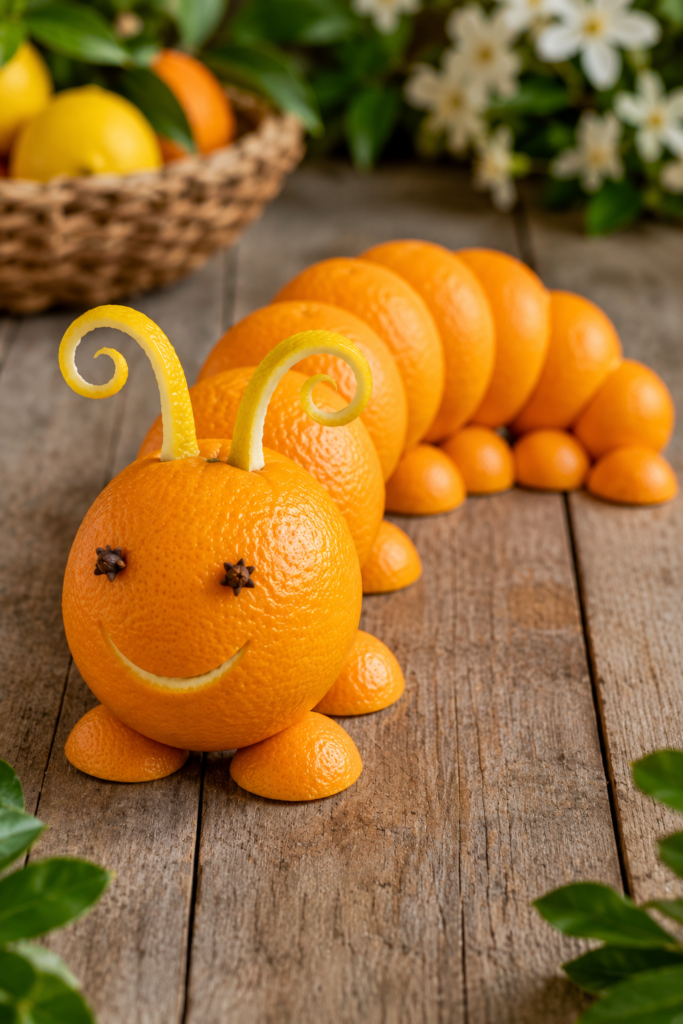
Three to five oranges, connected by toothpicks in a gentle curve, with cloves for eyes and a thin orange peel antenna. This sounds simple because it is. But the execution details matter.
The secret is using oranges of slightly different sizes, graduating from large to small toward the head end. This creates a natural tapering effect that reads as a living form rather than a lineup of identical spheres. The largest orange should anchor the tail. The smallest becomes the face.
Score concentric rings around the “face” orange for a textured, expressive appearance. Add thin lemon peel antennae curled around a skewer to create that classic caterpillar spiral.
5. Pineapple Parrot (Intermediate, 60-75 minutes)
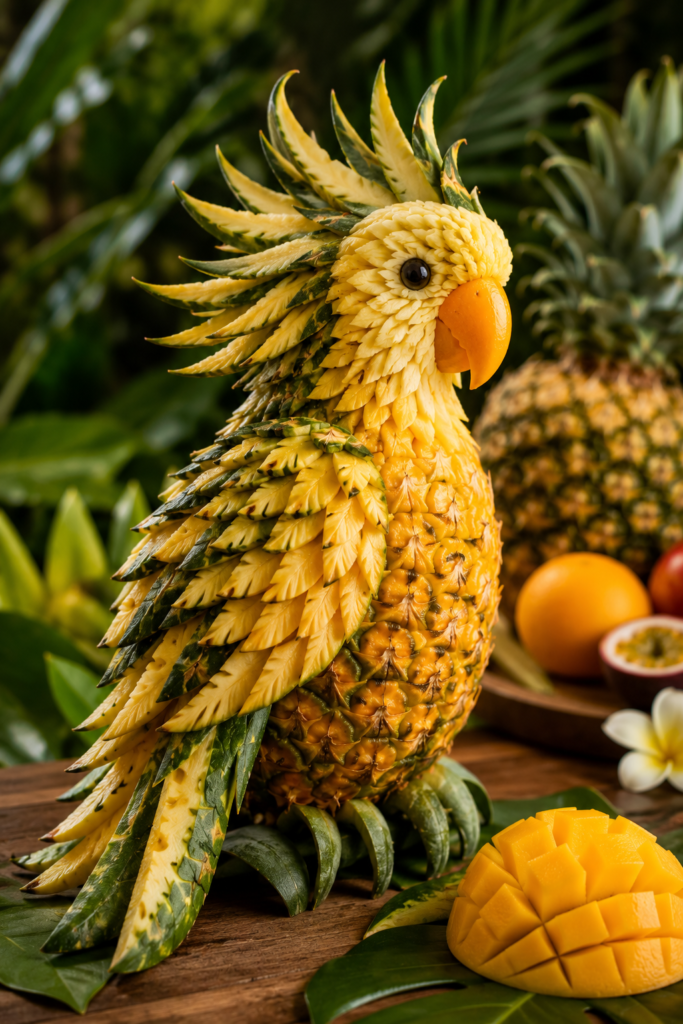
This is my personal favorite in the entire category. The pineapple parrot leverages the fruit’s natural drama in a way nothing else does.
Keep the crown intact. That’s your starting point. The crown becomes the parrot’s crest feathers. From the pineapple body, carve away sections to suggest folded wings, keeping the rough exterior texture to simulate feathers. Use a kumquat or small orange for the curved beak, securing with a toothpick at the appropriate angle. Two blueberries or grapes become the eyes.
The carved wing details require a small paring knife and patience. Work slowly and remove material in thin passes rather than aggressive cuts. Pineapple flesh is fibrous and will tear if you rush.
6. Pear Penguin (Beginner-Intermediate, 20-25 minutes)
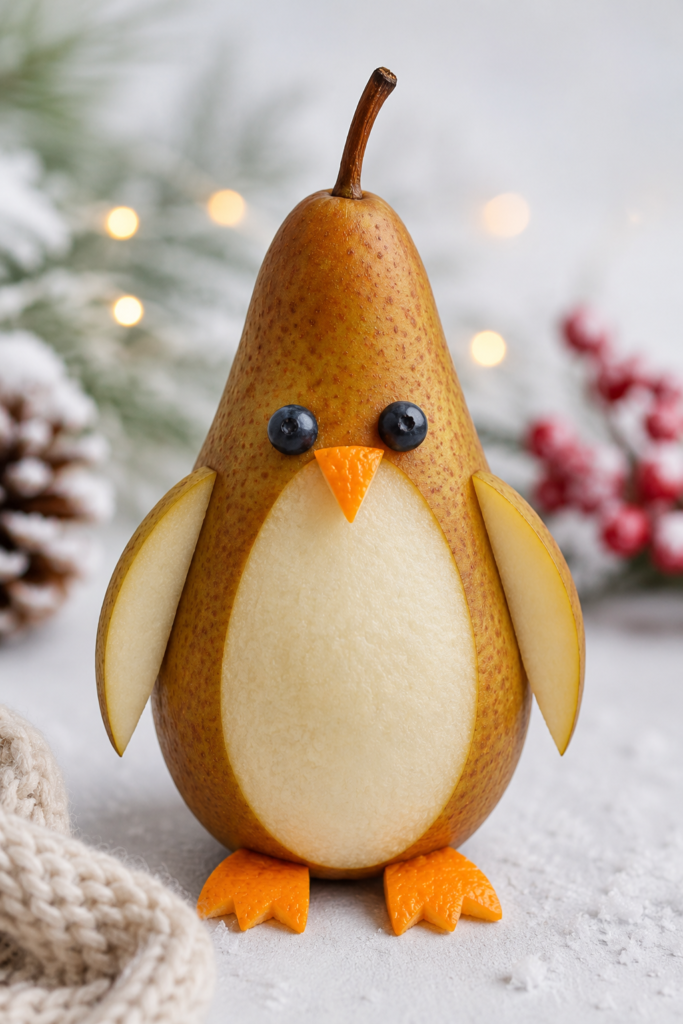
A Bosc pear’s dark yellow-brown skin and elongated body shape is nature’s penguin blueprint. This requires almost no carving. The narrow top becomes the head, the wide bottom is the belly.
Cut two small fin shapes from firm apple or carrot and attach to the sides. Use black grapes or blueberries for eyes. A small orange segment, cut into a triangle and pressed into the narrow end, creates a convincing beak. The pear’s natural color contrast between the darker skin and the pale flesh, visible at any cuts you make, adds visual depth.
7. Grape Caterpillar (Absolute Beginner, 5-8 minutes)
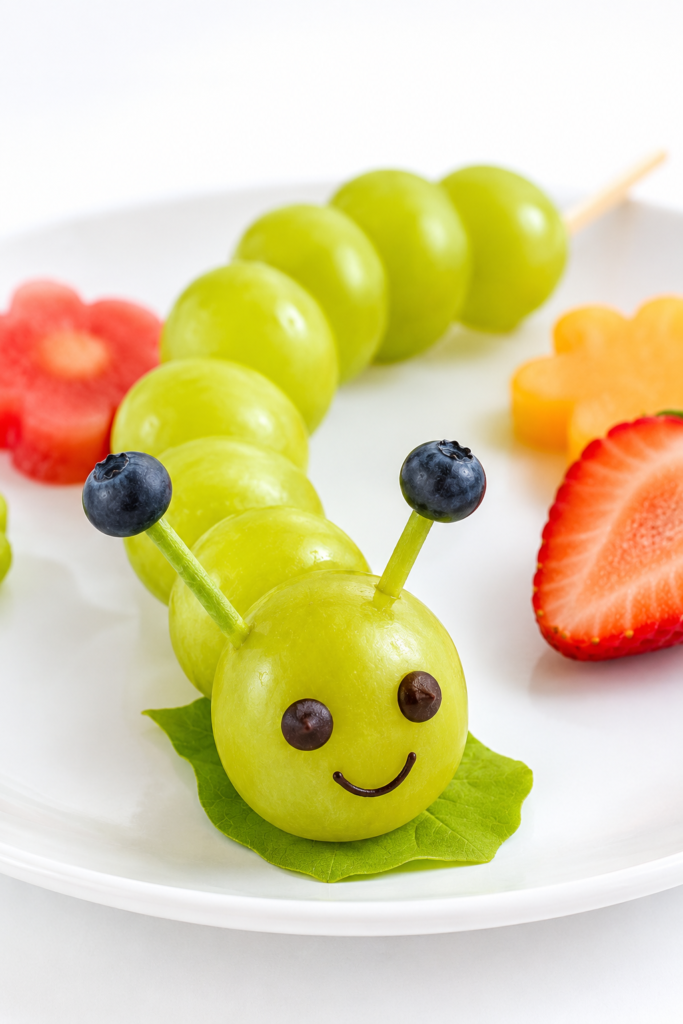
Thread green grapes onto a skewer in a gentle arc. Use two small toothpick segments attached to the front grape as antennae, with half a blueberry on each tip. Two small chocolate chips pressed into the front grape face become the eyes.
This is the project for children under five, for people who want a quick party garnish, or for anyone who needs an instant creative win. The skewer does the structural work. You do the aesthetic arrangement.
8. Watermelon Shark (Advanced Beginner, 30-40 minutes)
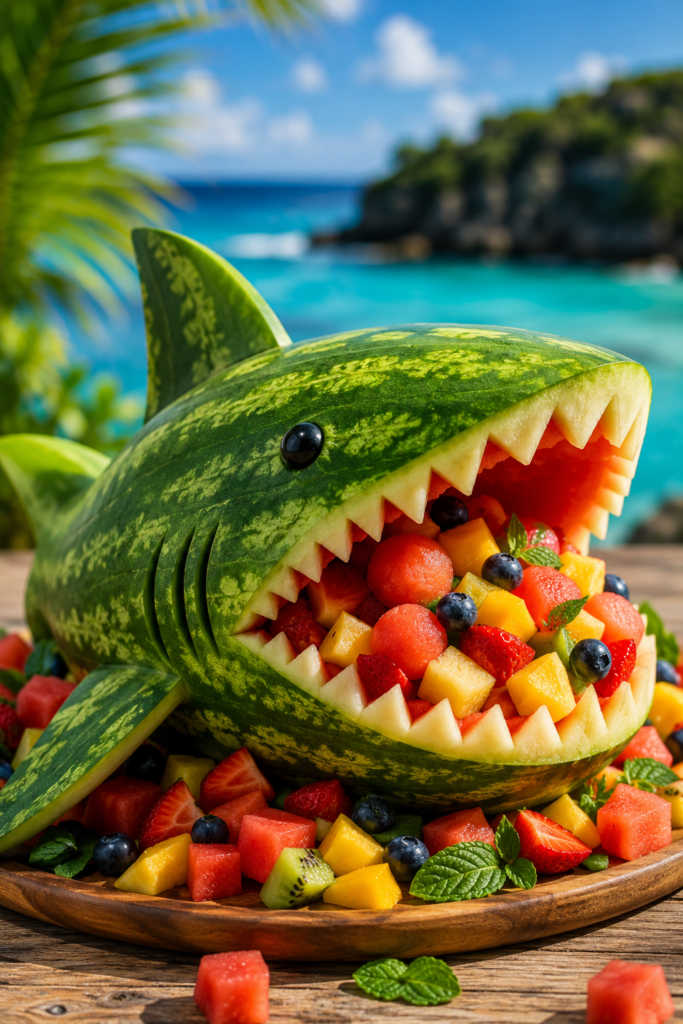
Lay your watermelon on its side. Cut the top third away. From this removed section, cut a triangular dorsal fin and set aside. Score the rim of the lower section in a zigzag pattern to suggest teeth. Scoop the flesh from the interior, mix with other fruit, and replace in the watermelon “mouth.”
Position the dorsal fin at the back of the remaining watermelon body using toothpicks. Add olive or grape eyes on the sides. The watermelon shark is consistently the most crowd-pleasing piece at summer gatherings, and it doubles as a serving vessel.
9. Cantaloupe Crab (Intermediate, 45 minutes)
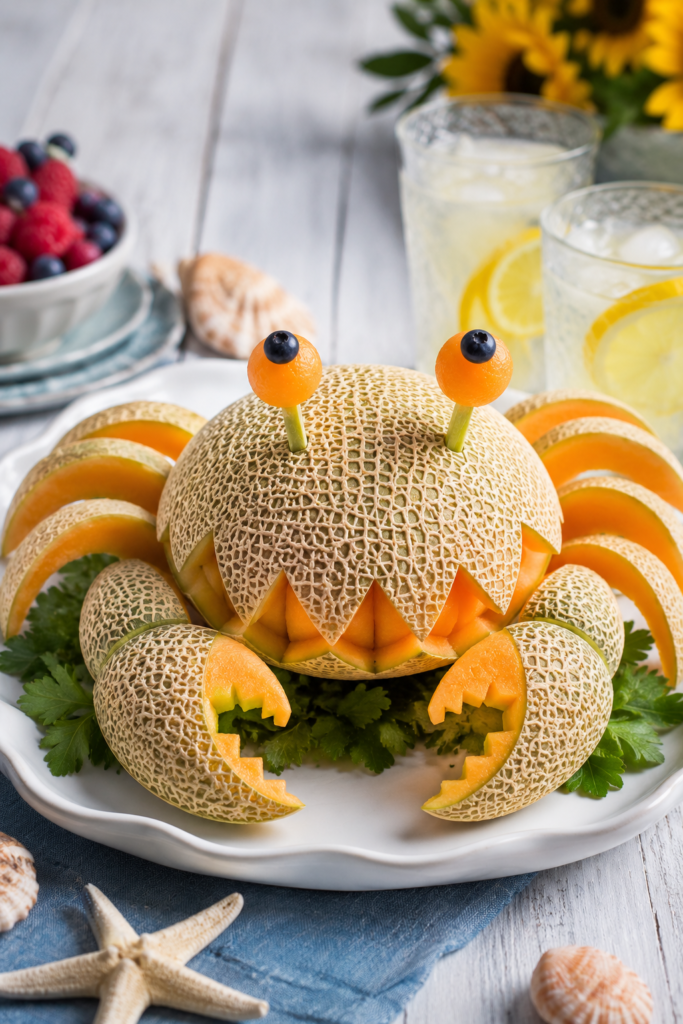
The cantaloupe’s netted orange skin is almost preternaturally crab-like in color and texture. Carve the body oval, then use long melon strips for legs, curving them outward on both sides. Smaller curved pieces become the front claws. Two orange segments on toothpicks provide the eye stalks.
The cantaloupe’s firm flesh holds complex cuts well, making this a better intermediate project than its apparent difficulty suggests.
10. Banana Dolphin (Intermediate, 30-35 minutes)
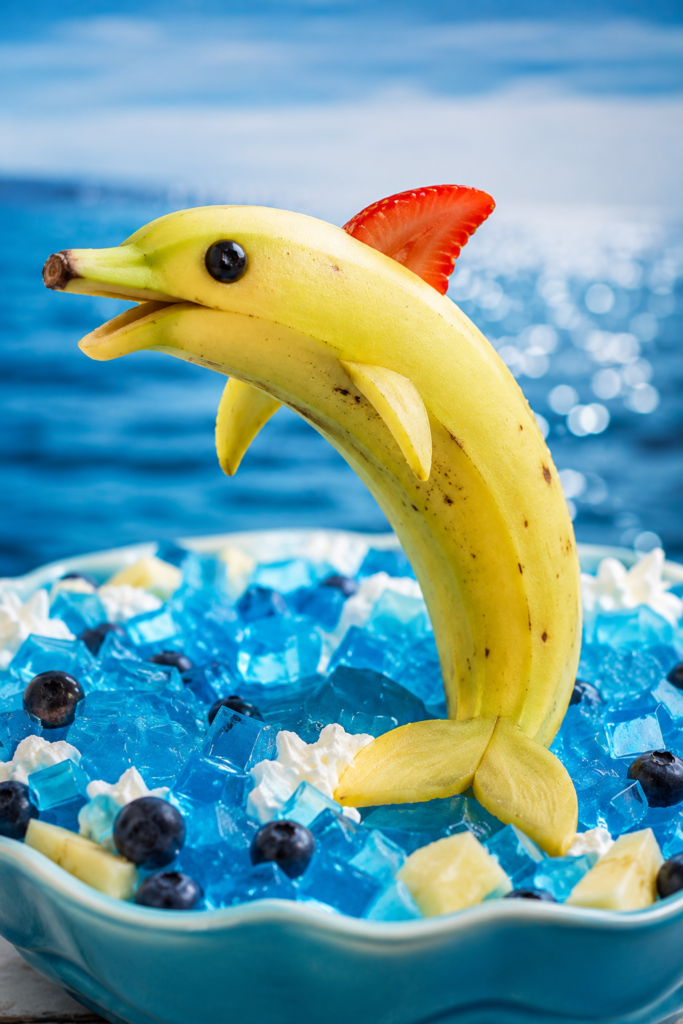
This one requires a counter-intuitive approach. Use a slightly underripe banana for maximum firmness. The natural curve of the banana becomes the dolphin’s leaping arc. Cut a small slit at the wide end and insert a thin apple slice as the tail fluke. A tiny strawberry or cherry on a toothpick becomes the dorsal fin.
The eyes are crucial here. Two cloves pressed into the skin at the correct anatomical position transform this from “banana with stuff stuck to it” into a genuinely convincing form. Placement matters more than any other single detail.
11. Kiwi Turtle Family (Intermediate, 40-50 minutes)
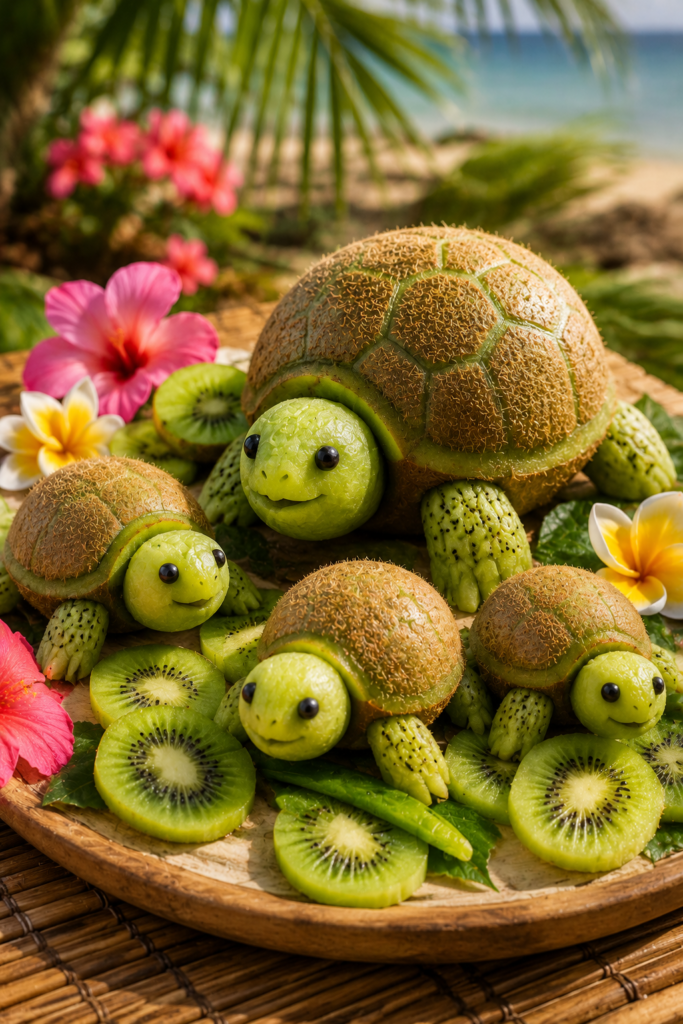
Halved kiwis, flesh side down, naturally suggest turtle shells through their green-bordered, seeded pattern. For each turtle, carve four small stumps from the kiwi flesh for legs, a small protrusion for the head, and a tiny tail nub. The natural pattern of the kiwi cross-section creates instant shell markings with no carving required.
Arrange three sizes together as a family grouping. The visual storytelling of the size progression elevates this from a single piece to a narrative composition.
12. Strawberry Crab (Beginner-Intermediate, 15-20 minutes)
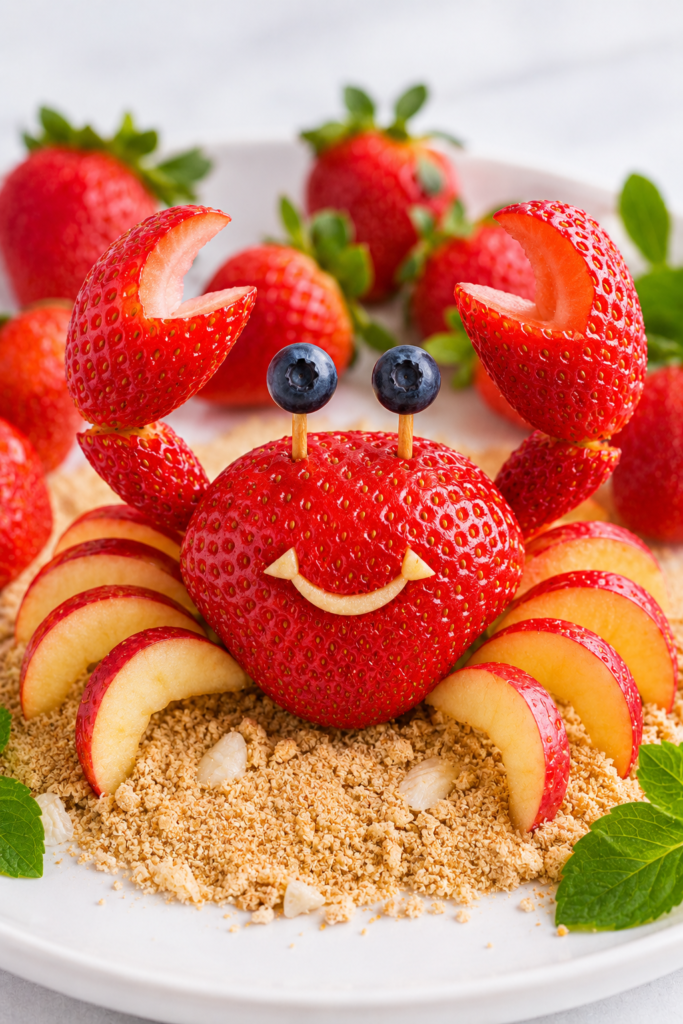
Two large strawberries form the body and the lifted claw. Thin apple slices, cut into leg shapes, attach along the sides. A blueberry balanced on a toothpick above the main strawberry creates a raised eye effect. The red of the strawberry perfectly mimics a cooked crab’s color.
This works beautifully as a single piece but becomes genuinely impressive when multiplied across a platter, creating the impression of a crab migration.
13. Lemon Chick (Beginner, 10-15 minutes)
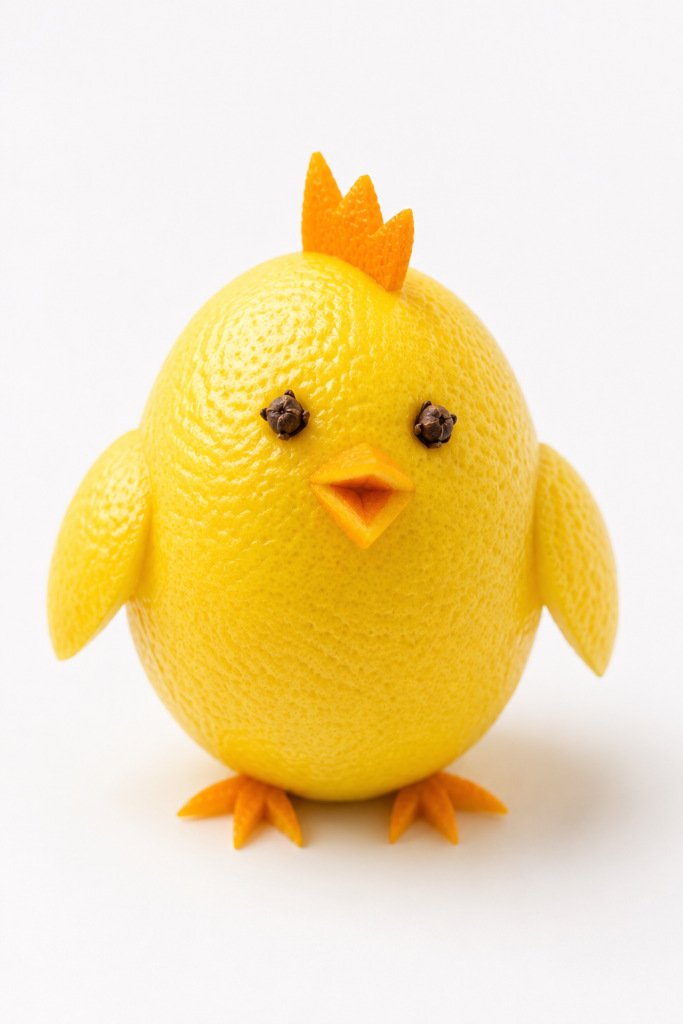
A lemon with a thin slice removed from the bottom to stabilize it, two tiny orange peel triangles pressed into the top as a beak and comb, and two cloves for eyes. That’s it. That’s the whole project.
The surprise here is how much personality emerges from minimal intervention. The lemon’s oval shape and yellow color do the thematic work. Your job is just to suggest the face. Less is genuinely more here, and that’s a lesson that applies across all fruit animals art.
14. Watermelon Fish Bowl (Advanced, 90-120 minutes)
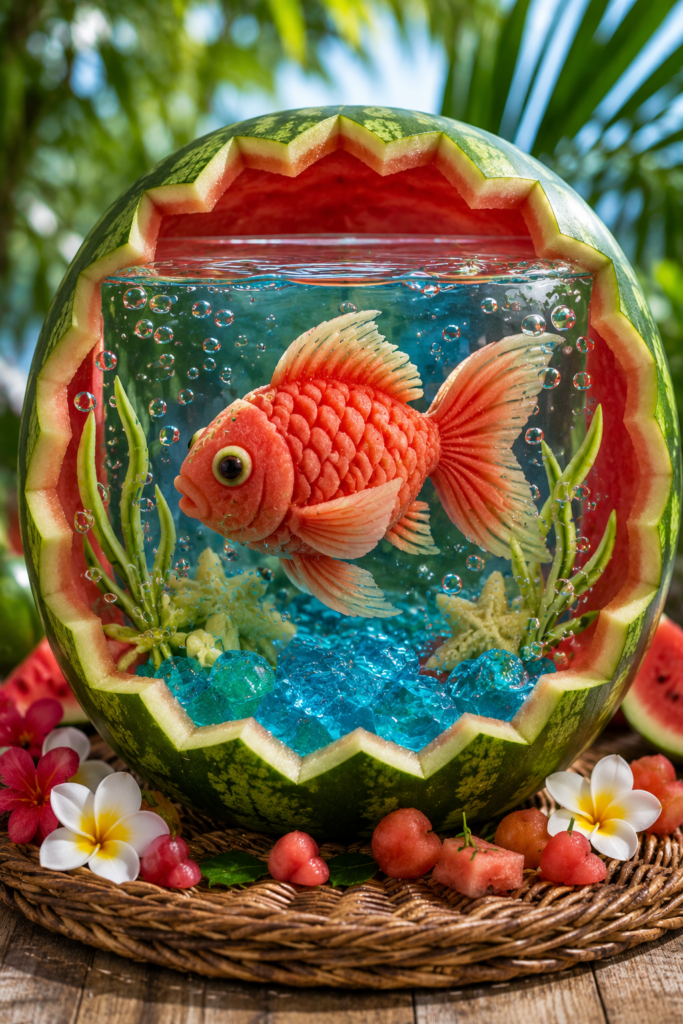
This is the showstopper. The project that photographs best, serves the most people, and generates the most conversation at any gathering.
Stand your watermelon vertically. Cut the top quarter away. Hollow the interior completely. From the removed section, carve fish shapes in various sizes. Score fin and scale details into each fish with a small paring knife. Suspend the carved fish inside the hollowed watermelon bowl using thin skewers at varying heights, creating the illusion of fish swimming in water. Fill the base with blue raspberry jello or simply leave it empty for the floating effect.
From the outside, cut the lower portion of the watermelon rind into wave shapes. The green of the exterior becomes ocean water. The carved fish hover inside.
This project takes practice. Expect your first attempt to take two to three hours. By the third attempt, you’ll complete it in ninety minutes. The gap between attempt one and attempt three is where the real artistic growth happens.
What Tools Do You Actually Need for Fruit Animals Art?
Most guides tell you to buy specialized carving sets. Here’s my honest assessment after using several of them.
The Victorinox Fibrox 3.25-inch paring knife (around $8-12, as of 2025) outperforms carving sets costing three to four times more for 80% of the projects in this guide. Its thin blade gives precise control. The slight flexibility prevents snapping on resistant rind. This is the one tool worth prioritizing.
A V-shaped linoleum carving tool (available at craft stores like Hobby Lobby or Michaels for around $6) works beautifully for scoring fine detail lines into melon rinds. It’s not marketed for food use, but it’s made of stainless steel and produces cleaner detail lines than most food-specific alternatives.
For the assembly projects (hedgehogs, caterpillars, crabs), plain wooden toothpicks work perfectly. Bamboo skewers, cut to length with scissors, handle heavier elements like the watermelon fish.
The tool I recommend against: large, aggressive carving knives for detail work. I’ve seen people try to carve strawberry details with a chef’s knife. The results are consistently poor. Match tool size to fruit size.
How Do You Keep Fruit Animals Art Fresh Longer?
The three-technique approach works best: lemon juice treatment for cut surfaces, refrigeration at 35-38°F (2-3°C), and plastic wrap contact coverage for exposed flesh. Together, these extend display life from 30 minutes to 3-4 hours.
Lemon juice is your most powerful tool. The citric acid slows oxidation significantly on apples, pears, and bananas. Brush it on immediately after cutting, before you do anything else.
For watermelon and citrus projects, oxidation is less of a concern. Drying out is the real enemy. A light mist of water from a spray bottle, applied every thirty to forty-five minutes, keeps the flesh looking fresh and vibrant.
The cold chain matters. Assemble in a cool room if possible. Move pieces to refrigeration immediately after completing each component. Assemble the final piece as close to display time as you can manage.
One genuine insider tip: cut surfaces that face upward dry out far faster than those facing down or inward. When designing your animal’s orientation, think about which surfaces will be most exposed. Position the piece to minimize upward-facing cuts where possible.
Frequently Asked Questions About Fruit Animals Art
Can kids make fruit animals art safely?
Yes, with appropriate supervision and project selection. The strawberry hedgehog, grape caterpillar, and lemon chick require no knife work at all. Children eight and older can handle the apple swan with a supervised adult. Save knife work entirely for adults. The assembly and decorating is where children can fully participate.
What’s the best fruit for carving beginners?
Firm, slightly underripe pears and apples are the most forgiving for beginners attempting carved projects. Their flesh holds a cut edge cleanly, they don’t oxidize as rapidly as some alternatives, and they’re inexpensive enough to practice with repeatedly.
How far in advance can I make fruit animals art?
For display, two to three hours maximum for most cut projects. For photography, make it and shoot it immediately. Assembled-only pieces (grape caterpillar, strawberry hedgehog) with no cut surfaces can hold overnight in the refrigerator if covered with plastic wrap.
Do I need any art experience?
No. The assembly projects in this guide require no artistic skill, just patience and attention to placement. The carving projects benefit from steady hands but respond well to slow, deliberate work. Speed is the enemy of good fruit carving.
What fruits work for fruit stamping animal art?
Halved apples create beautiful star patterns. Celery stumps make rose prints. Lemon halves produce perfect circular stamps. For animal shapes specifically, carved potato stamping is more practical than fruit, but apple slices carved into simple fish or bird profiles stamp cleanly onto paper.
Is fruit animals art worth learning for professional food styling?
Yes, with one caveat. The specific skills transfer directly: understanding material behavior, working quickly under time constraints, and thinking three-dimensionally about food forms are all valued in professional food styling. The carving techniques themselves appear in high-end hospitality contexts. Several professional food stylists I’ve spoken with cite fruit carving practice as foundational to their eye for form.
What’s the hardest fruit animal to make?
Honestly? A convincing bird with spread wings from a single piece of melon. The structural challenge of creating cantilevered wing elements that don’t collapse under their own weight, combined with the time pressure of working melon, makes it the most technically demanding project in this category.
The Bigger Picture: Why Fruit Animals Art Matters More Than It Looks
Here’s the opinion I hold that most food art communities would push back on: fruit animals art is a legitimate gateway to three-dimensional thinking that transfers across creative disciplines.
The spatial reasoning you develop when turning a watermelon into a turtle, when understanding how a cut from this angle creates that shadow, when planning a composition that works from multiple viewing angles, that skill set shows up in sculpture, in interior design, in product design, in architectural thinking.
I’ve watched people discover genuine artistic confidence through fruit carving who had spent years convinced they “weren’t creative.” The combination of immediate feedback, low-stakes materials, and visually dramatic results creates an unusually effective learning environment.
The community around fruit animals art has grown significantly through platforms like Pinterest and Instagram, but the best learning still happens in person, watching someone else’s hands. If you can find a local workshop, go. If you can’t, the next best thing is slowing down tutorial videos to 50% speed and watching every individual cut.
Start with the strawberry hedgehog. Make it three times in one week. By the third one, you’ll notice your placement decisions becoming more deliberate, your blueberry rows more even, your results more consistent. That consistency is the foundation everything else builds on.
What fruit animal are you planning to try first? And more interestingly: which one intimidates you most? The answer to that second question is almost always the one worth attempting next.