
14 Santa Veggie Tray Ideas That Will Actually Wow Your Holiday Guests
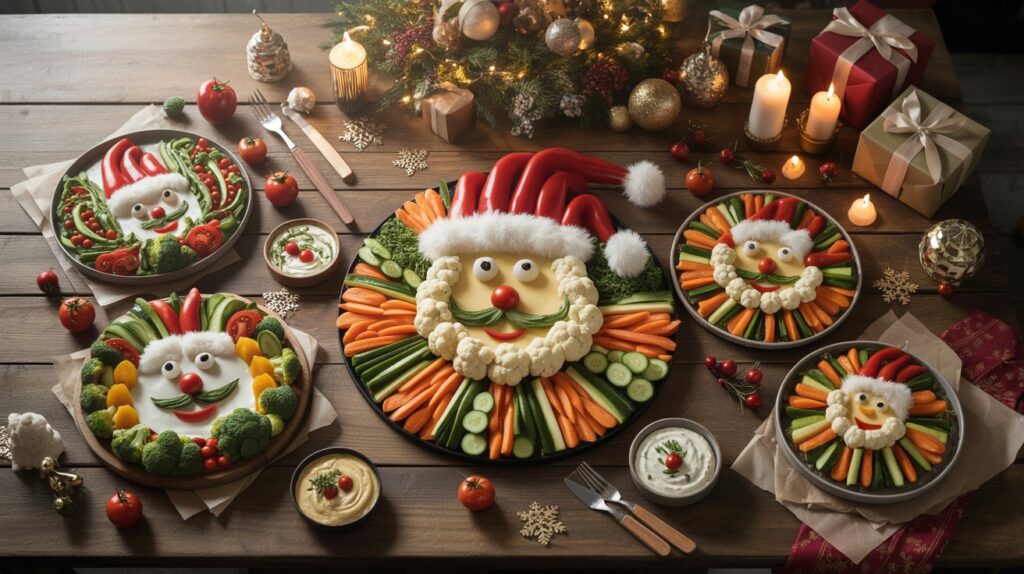
Every December, the same thing happens at holiday parties across the country. Someone brings a sad, pre-packaged veggie tray from the grocery store, drops it on the table next to the cheese board, and it sits there—wilting, ignored—while guests crowd around the baked brie. Sound familiar?
Here’s the uncomfortable truth most holiday entertaining guides won’t say out loud: a standard veggie tray is a party afterthought. It signals “I ran out of ideas.” But a Santa-themed veggie tray? That stops people in their tracks. Kids abandon the cookie table. Adults pull out their phones. Your tray becomes the centerpiece, not an obligation.
I’ve made more Santa veggie tray than I can count over the past eight years—for family gatherings of 12, office parties of 60, and everything in between. I’ve had spectacular failures (more on that shortly) and I’ve landed on combinations that genuinely work. This guide covers 14 specific Santa veggie tray ideas, ranked roughly from beginner-friendly to genuinely impressive, with honest notes on what actually goes wrong and how to prevent it.
Whether you have 20 minutes or two hours, you’ll find something here worth making.
What Makes a Santa Veggie Tray Actually Work?
Before diving into the specific designs, let’s talk about what separates a great Santa veggie tray from a forgettable one. The answer comes down to three things: color accuracy, structural integrity, and a readable face from across the room.
Color accuracy means using vegetables that genuinely read as red, white, and skin-toned. Red bell peppers are your best friend here. Cherry tomatoes work but bleed moisture quickly. Cauliflower is the ideal white—firmer than jicama, cheaper than daikon, and universally beloved. For Santa’s face/skin tone, most people reach for hummus or pale-colored dip, but a block of cream cheese works better because it holds its shape for hours.
Structural integrity is the part nobody talks about. Your tray needs to survive two to three hours at room temperature without collapsing. Cucumbers become watery. Grape tomatoes roll. Broccoli “trees” tip over. I’ll point out the structural weak points in each design below.
Readability from a distance matters more than close-up perfection. Step back six feet from your finished tray. Does it read as Santa? If you squint and it looks like a pile of vegetables, guests won’t get it until they’re right on top of it.
14 Santa Veggie Tray Ideas, From Simple to Spectacular
1. The Classic Santa Face

This is the one that started the trend, and it remains the most beginner-accessible design. You need a large oval or round platter (14 to 16 inches works best), red bell pepper strips for the hat, cauliflower florets for the beard and hat trim, a few black olives for eyes, a cherry tomato nose, and a red bell pepper ring for the mouth.
Arrange your hat first—diagonal strips of red pepper across the upper third of the platter. Then frame the bottom two-thirds with a thick, layered beard of cauliflower. Eyes go in the upper-center area, cherry tomato nose just below center, and the pepper-ring smile beneath that.
What goes wrong: People make the beard too sparse. Cauliflower needs to be densely packed or it looks like a patchy, depressing attempt at facial hair. Use more than you think you need—usually two full heads of cauliflower for a standard platter.
Time investment: 25 to 30 minutes.
2. The Santa Hat Tray
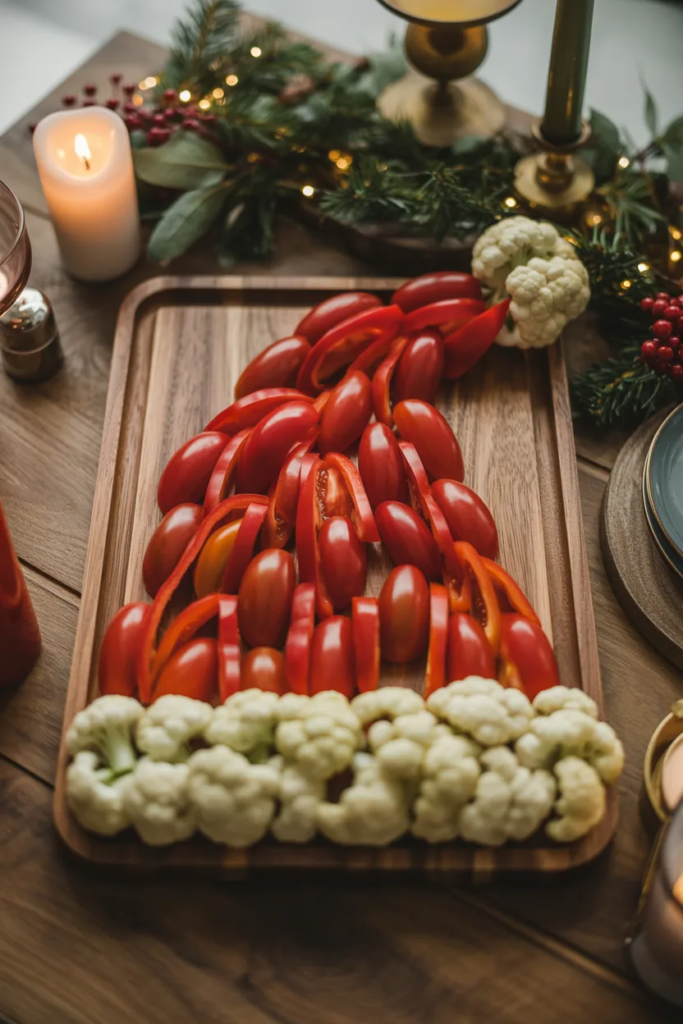
Skip the face entirely and make just the hat. This works brilliantly for long rectangular platters (think a standard 18-by-12-inch serving board) and is by far the easiest design to execute well.
The hat body is red bell pepper strips or baby tomatoes arranged in a triangle pointing upward. The white brim across the bottom is cauliflower or cream cheese piped in a thick stripe. The pompom at the tip is a cluster of cauliflower florets or a small ball of cream cheese.
Here’s the contrarian take: the Santa hat tray is actually more visually striking than the full Santa face for adult parties. It photographs beautifully, reads instantly, and the simpler geometry means you can execute it more precisely. I served this at an office holiday party of 45 people in 2022, and it got more compliments than any tray I’d brought with a full face design.
Pro tip: Use a mix of red bell pepper strips AND cherry tomatoes for the hat body. The different textures and slight color variation look intentional and upscale.
Time investment: 15 to 20 minutes.
3. The Full-Body Santa
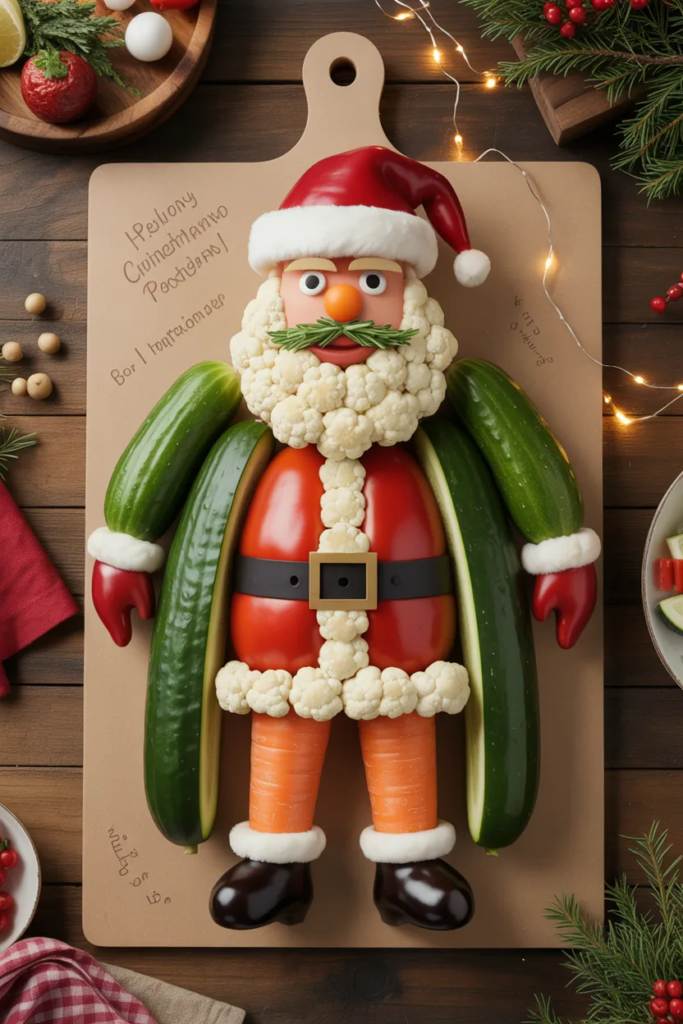
This one requires a large rectangular board—at minimum 20 by 15 inches, ideally more. You’re building a complete Santa figure: hat at the top, round face in the upper center, coat body below, belt across the middle, and boots at the bottom.
Use cucumbers (sliced into rounds) for the coat body. A thick strip of black olives or black beans makes the belt. Baby carrots arranged in two columns become the legs. Black olive halves at the bottom form the boots.
This design is ambitious and genuinely impressive when it works. The face section follows the same logic as Design 1. The coat works well. Here’s what always goes sideways: the belt. Black olive halves are slippery and refuse to stay in a straight line. I recommend using a thin strip of cream cheese as “mortar” beneath the olive halves to anchor them.
Time investment: 45 to 60 minutes.
Skill level: Intermediate. Don’t attempt this as your first Santa tray.
4. Santa’s Sleigh and Reindeer
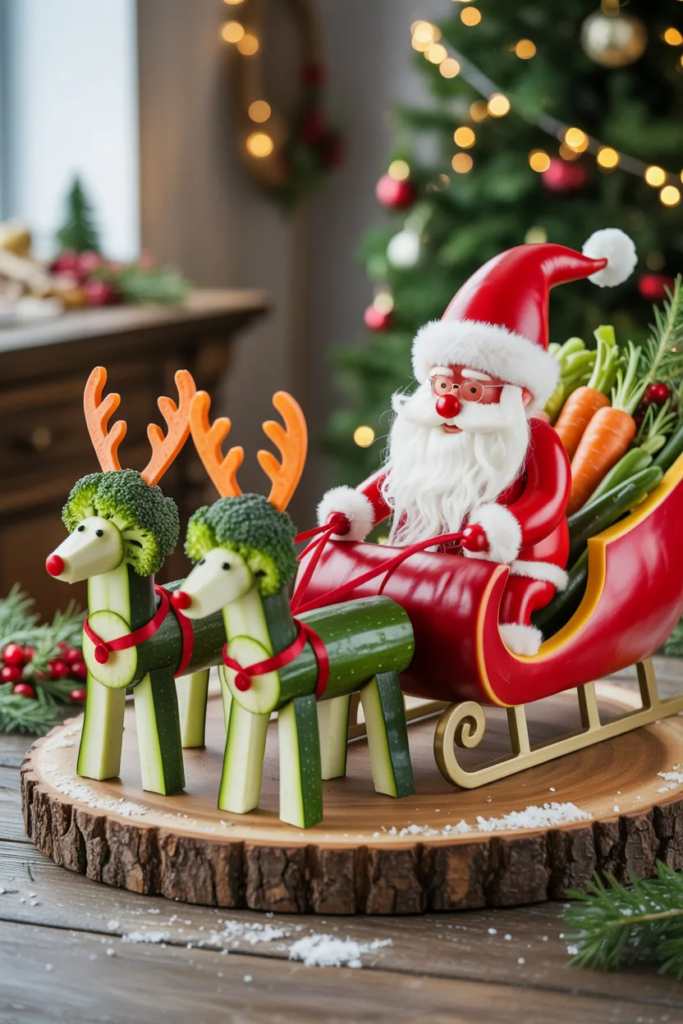
This one is for the overachievers. Use a large board and create a side-profile silhouette of Santa in his sleigh with one or two reindeer outlines. Broccoli florets become the reindeer bodies. Baby carrots form the antlers (halved lengthwise and fanned out). The sleigh body is red bell pepper strips.
Here’s my honest assessment: this design requires genuine artistic comfort with arranging food. If you’re not someone who naturally thinks spatially, it will look like a vegetable explosion rather than a sleigh scene. The upside is that when it works, it’s legitimately jaw-dropping.
What actually goes wrong: Broccoli florets for reindeer bodies tend to be too compact and dark to read clearly. A better material is sliced zucchini rounds layered to suggest a body shape, with broccoli for texture.
Time investment: 75 to 90 minutes.
5. Santa Claus in a Bowl
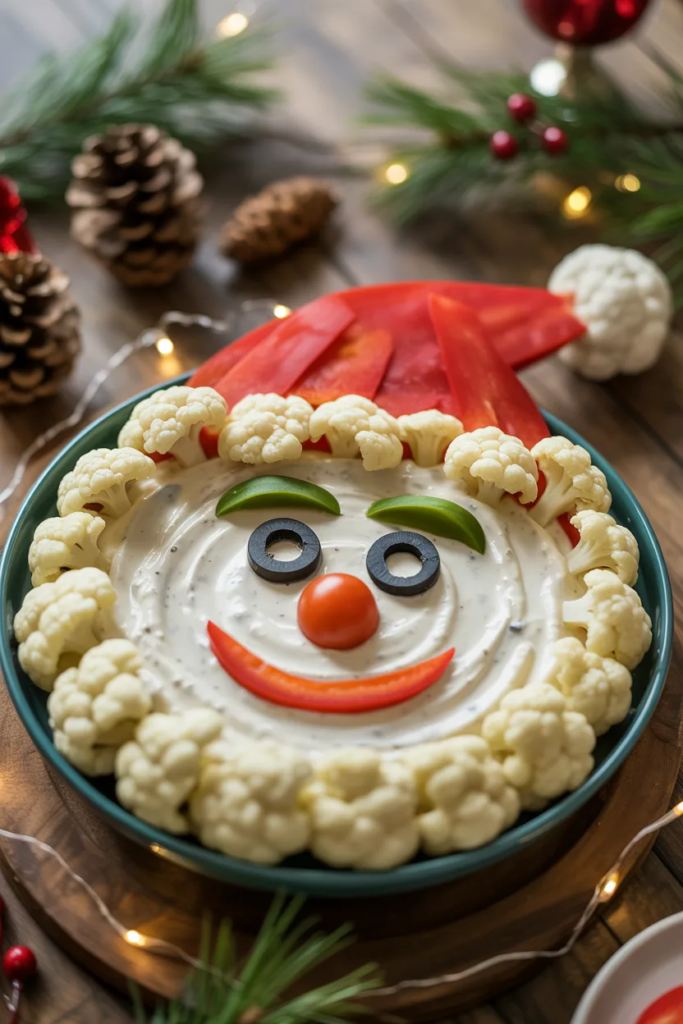
This is my favorite design for practical entertaining, and I’m surprised it doesn’t show up more often. Use a large, round white serving bowl (a salad bowl works perfectly) and build the face using the interior of the bowl as the “face.” The bowl’s rim becomes the frame. Fill the bowl with your chosen veggie dip. Then arrange the face elements on top of the dip surface—olive eyes, a cherry tomato nose, a sliced red pepper smile.
Surround the outside of the bowl with tightly packed cauliflower for the beard and red pepper strips for the hat brim.
The genius of this approach: your dip is built in. Guests scoop directly from the “face,” which means the face slowly disappears over the course of the party (a conversation piece in itself). The bowl prevents the structural collapse issues that plague flat trays. And cleanup is dramatically easier.
Dip recommendation: Use a red pepper hummus inside the bowl for maximum color impact, or stick with classic ranch if your crowd is traditional.
Time investment: 20 to 25 minutes.
6. The Santa Wreath with a Face
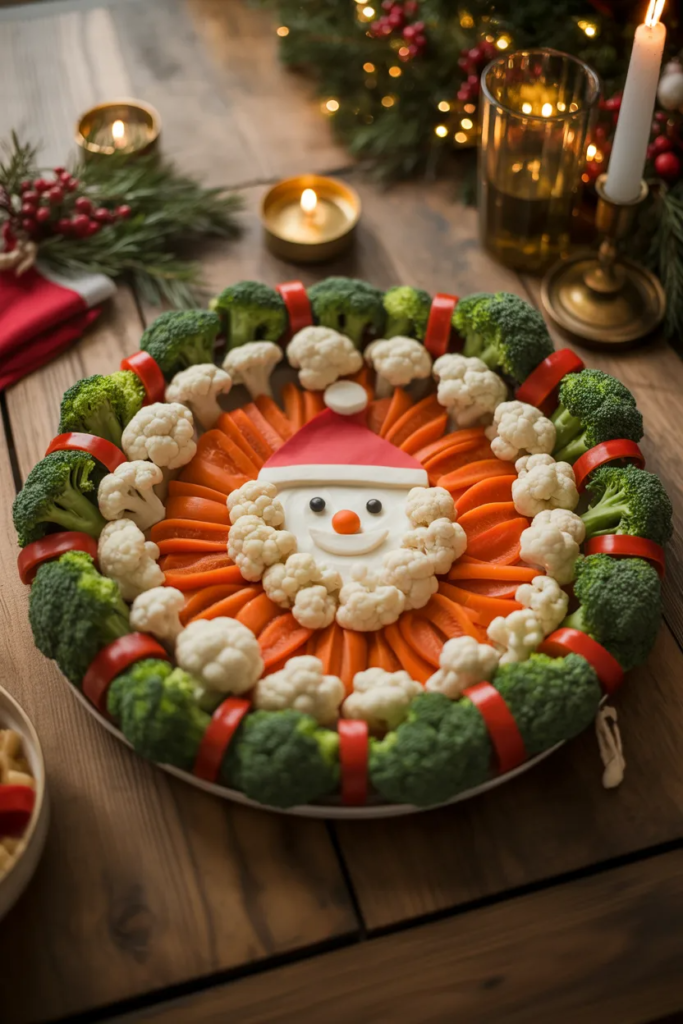
Take a round platter or a large wooden board. Arrange broccoli and cauliflower florets in a thick ring around the outer edge—this is the wreath. Add scattered red bell pepper “bows” or cherry tomato accents. Then in the center of the wreath, build a small Santa face using the same techniques from Design 1, but scaled down to fit the center circle.
This design works exceptionally well for holiday buffet tables because it fills a lot of visual space without requiring the tight precision of a full-body design. It also satisfies guests who want both a Christmas-green element (the broccoli wreath) and the Santa element.
Time investment: 30 to 35 minutes.
7. The Stacked Platter Santa
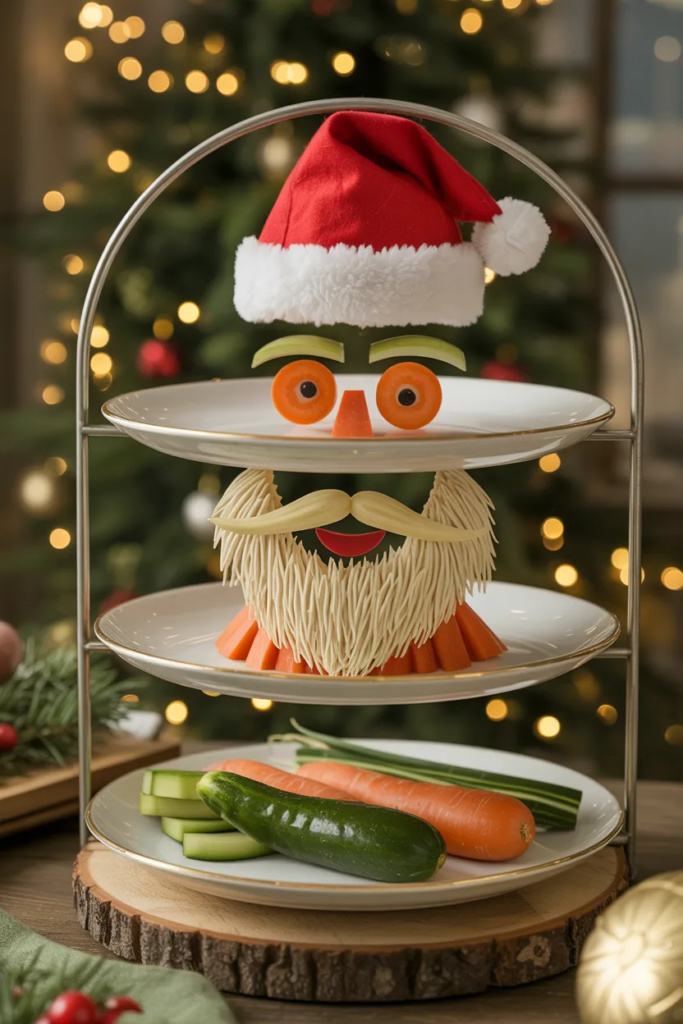
This is genuinely clever and I’ve only seen it done a handful of times. Use two or three tiered serving platters stacked vertically. The top tier holds just the hat (red pepper strips and cauliflower pompom). The middle tier holds the Santa face. The bottom tier holds the beard and body.
The three-dimensional, stacked presentation photographs beautifully from a slight angle. It also solves the space problem on crowded buffet tables because it builds up instead of out.
Practical note: The platters must be stable. Use a tiered server specifically designed for this, not plates balanced on cups. I learned this lesson the hard way at a family Christmas when the top tier slid off, launching cherry tomatoes across a freshly vacuumed carpet.
Time investment: 35 to 40 minutes.
8. Santa with a Dip Beard

Here’s where it gets creative. Instead of using cauliflower for the beard, pipe whipped cream cheese or white bean dip in thick, swirled patterns to create the beard texture. Use a star tip on a piping bag for an impressive layered effect, or just spread it with a butter knife for a quicker approach.
The cream cheese beard holds its shape for three to four hours (far longer than cauliflower), looks incredibly realistic, and doubles as dip for any vegetables guests want to use for scooping. This is genuinely the most practical beard material, and I switched to it permanently after the 2021 holiday season.
The downside: Guests who don’t like cream cheese or dairy feel excluded. If you’re hosting for dietary restrictions, stick with cauliflower or use a white bean dip instead.
Time investment: 25 to 30 minutes.
9. Mini Santa Individual Cups
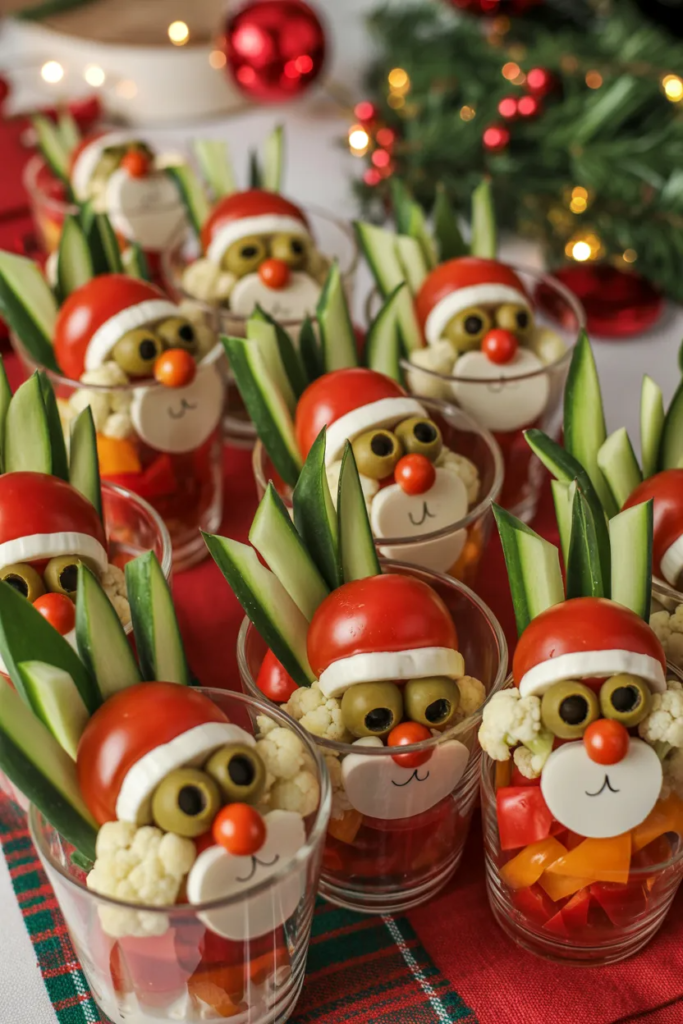
Instead of one large tray, create individual Santa-themed veggie cups for each place setting. Use clear plastic cups or small mason jars. Fill each one with a small amount of dip in the bottom. Arrange vegetables to create a Santa face on each cup—you can tape a small Santa hat cutout to the rim, or create the hat effect with two small red pepper triangles and a cauliflower dot.
This approach is perfect for seated dinner parties rather than buffets. Each guest has their own personal Santa, which dramatically increases engagement and feels more upscale than a shared tray. The prep time is higher per cup but the overall waste is lower (no wilted leftover tray at the end of the party).
For a party of 12, budget 45 to 60 minutes for assembly.
10. The Rainbow Santa (All Vegetables, Maximum Color)
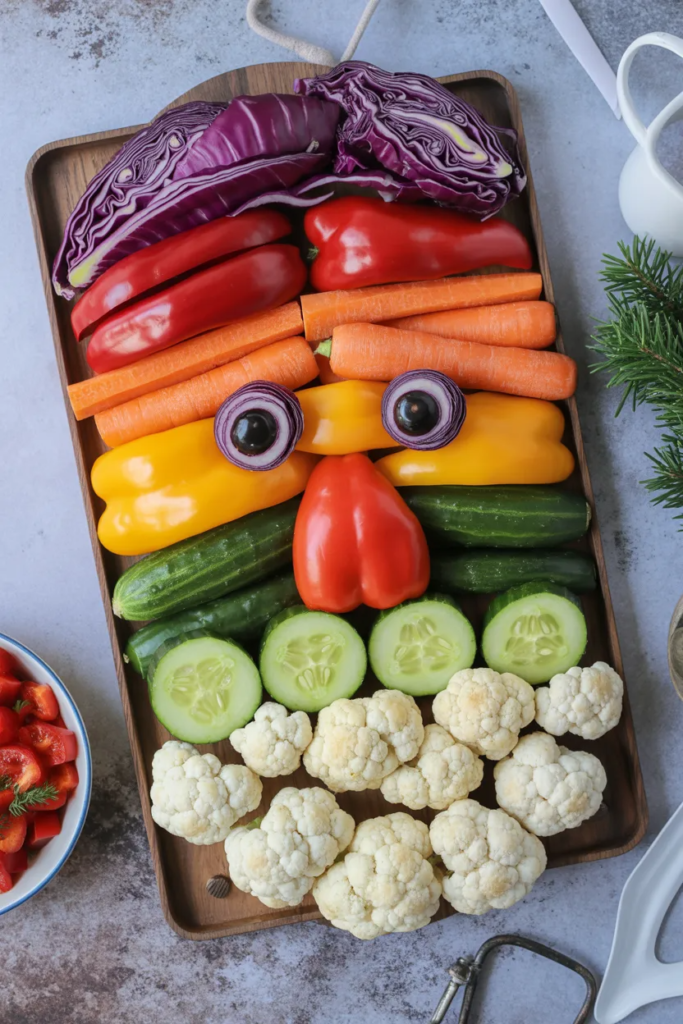
Most Santa trays default to a limited palette: red, white, and maybe black. This design pushes further by using every available vegetable color while still creating a readable Santa figure.
Yellow bell pepper strips form a golden hat band. Orange carrot sticks layer into the coat. Purple cabbage shreds create shadows and depth in the beard. Green cucumber rounds tile the background. Cherry tomatoes and red bell pepper cover the hat and coat.
The result is a Santa who looks like he’s been painted by a food stylist. It’s visually spectacular, genuinely festive, and offers far more nutritional and flavor variety than the standard red-and-white approach.
Critical warning: Color coherence is everything here. If the purple cabbage bleeds into the white cauliflower, the whole beard looks gray and sad. Keep a border of empty platter space between any purple/dark element and any white element, and assemble this no more than one hour before serving.
Time investment: 40 to 50 minutes.
11. Santa in the Snow (Dip Landscape)
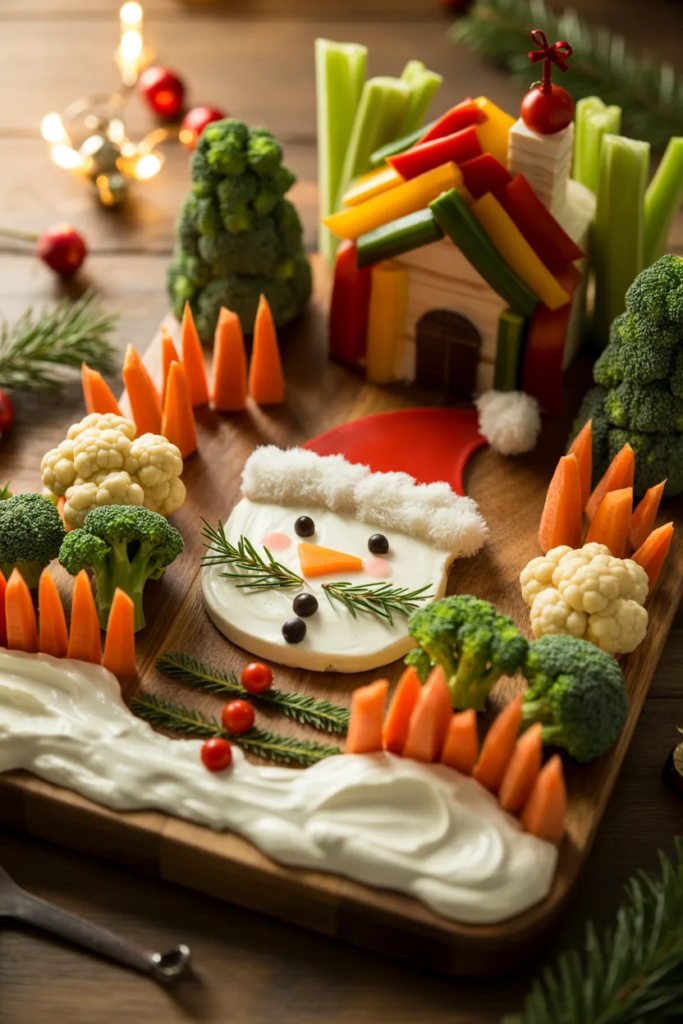
This design requires a large rectangular board and treats the surface as a scene rather than just a face. Spread a thick layer of white dip—cream cheese, ranch, or white bean—across the lower third of the board as “snow.” Arrange vegetables in the snow: baby carrots as candy canes, broccoli florets as Christmas trees, radish roses as ornaments.
In the upper center, build Santa’s face using the standard cauliflower-and-pepper technique. But now he’s surrounded by a complete holiday scene. Add a “chimney” of stacked red bell pepper squares on one side.
This is the most visually complex tray in this list and the one that most rewards careful planning. I’d suggest sketching the layout on paper before you start cutting vegetables. The landscape approach gives you more creative freedom but also more ways to go wrong.
Time investment: 60 to 75 minutes.
12. The Quick 15-Minute Santa (For Real Life)

Let’s be honest: most people reading this are making this tray the morning of a holiday party while simultaneously managing children, cooking other food, and wondering where they put the tape for the gift wrapping. So here’s the genuinely fast version.
Large oval platter. Spread ranch dip across the bottom half in a rough oval for the face. Dump a pile of cauliflower across the lower third for the beard. Lay red pepper strips across the top third for the hat. Add a cluster of cauliflower at the tip for the pompom. Press two black olives for eyes, one cherry tomato for a nose, and curve a strip of red pepper for the mouth.
Done. It takes 12 to 15 minutes, it reads instantly as Santa, and nobody at your party is going to grade it on artistic merit.
This is the version I actually make when I’m short on time, and it consistently gets compliments. Perfect execution is overrated. A recognizable Santa tray made with care in limited time beats a fussy design that stressed you out before the party even started.
13. Santa and Mrs. Claus Side by Side
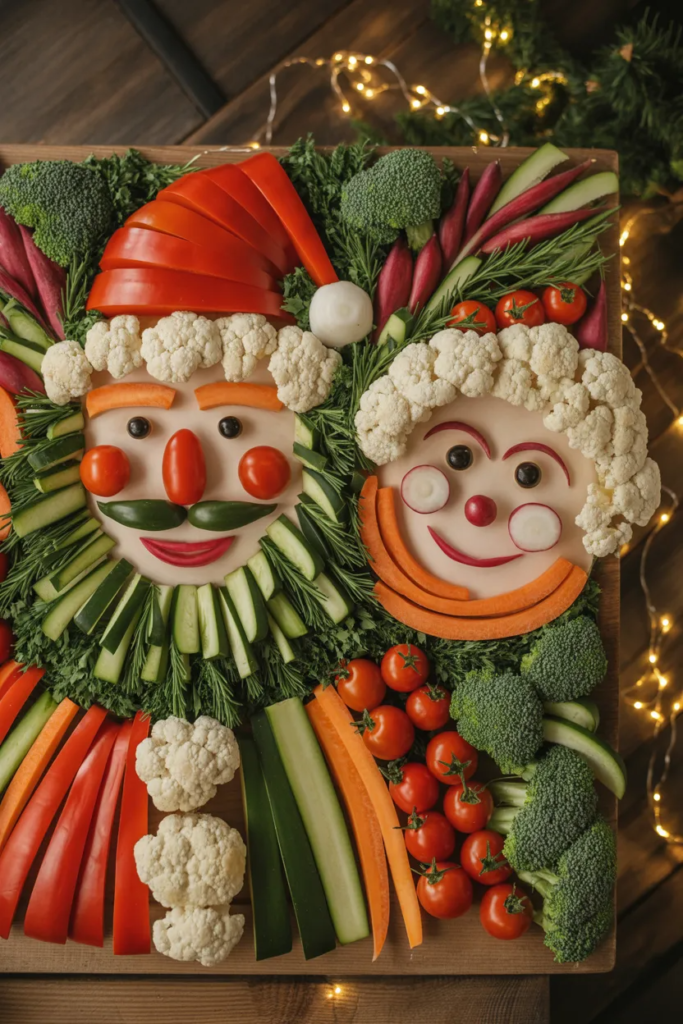
Double your platter size and create two Santa faces side by side—one for Santa (the traditional red hat) and one for Mrs. Claus (give her a bonnet made from white cauliflower with small red pepper accents). The two faces look wonderful facing each other and the doubling of vegetables means more variety for guests to graze.
The Mrs. Claus variation: use cauliflower more prominently for her bonnet and hair. Use a cherry tomato for her nose, same as Santa. A slight smile (curved red pepper strip) versus Santa’s broader, more jolly grin creates personality differentiation between the two.
Time investment: 50 to 60 minutes. This is worth the extra time if your platter space allows it.
14. The Interactive Santa Build-Your-Own Tray

This last one is less about a pre-made design and more about creating an experience—particularly powerful for families with young children. Set out all the Santa components in separate bowls: cauliflower florets, red bell pepper strips, cherry tomatoes, black olives, cream cheese. Provide each child (or adult, honestly) with an individual small plate or board.
Let everyone build their own Santa face. The results will be chaotic, charming, and occasionally terrifying. A child’s Santa might have 12 olive eyes and no beard. That’s fine. The activity itself becomes the entertainment.
Practical note: Pre-cut everything so small hands can place pieces without needing knives. This also works remarkably well for work parties where adults enjoy the low-stakes creative activity more than they’ll admit.
Time investment: 20 minutes of prep, then it runs itself.
The Vegetables That Actually Work (And the Ones That Don’t)
Here’s the honest breakdown after years of testing:
Excellent choices:
- Cauliflower: The undisputed king of white beards and hat trim. Holds shape, stays dry, tastes good with every dip.
- Red bell peppers: Perfect color, sturdy, easy to cut into strips and shapes.
- Baby carrots: Reliable nose alternative and great for structural elements.
- Black olives: Essential for eyes. Kalamata olives are too dark and don’t read clearly. Use standard canned black olives.
- Broccoli florets: Good for green accent elements and wreath designs. Keep dry before using.
Use with caution:
- Cherry tomatoes: Great color but they roll, they moisture-bleed, and they go wrinkled after two hours. Use them but place them last and serve promptly.
- Cucumber rounds: Beautiful but weepy. Pat dry with paper towels and add no more than 30 minutes before serving.
- Radishes: Excellent for color accents when sliced thin, but they dry out and curl within 90 minutes.
Avoid entirely for Santa trays:
- Celery for structural elements (too bendy)
- Raw beets (they stain everything red, including your cauliflower beard)
- Grape tomatoes on their own (they’ll escape across the table)
Frequently Asked Questions About Santa Veggie Trays
How far in advance can I make a Santa veggie tray?
Assemble it no more than two to three hours before serving for maximum freshness. You can prep all the vegetables the night before—cut, washed, dried, and stored in airtight containers. But final assembly should happen the day of the party. The exception is cream cheese elements, which can be applied earlier since they won’t wilt.
What size platter do I need?
For a face-only design, a 14-to-16-inch round platter is ideal. For full-body designs, you need at least 18-by-14 inches. For side-by-side or scene designs, go 20-by-16 inches or larger. When in doubt, go bigger. A face that fills its platter looks bold; one that’s lost in empty space looks tentative.
How do I keep the vegetables from sliding around?
A thin base layer of dip or cream cheese acts as edible glue. Spread a very thin layer across the platter surface before arranging vegetables on top. This is the single most effective trick for keeping designs intact during transportation.
What dip goes best with a Santa veggie tray?
Ranch remains the crowd-pleasing default, and for good reason. It pairs with every vegetable, children love it, and the white color doesn’t visually compete with your design. For adult parties, a roasted red pepper hummus adds sophistication and complements the red-and-white color story beautifully.
Can I make a Santa veggie tray without cauliflower?
Yes, but your options narrow. Cream cheese or white bean dip piped into beard shapes works well. Jicama cut into small cubes is another option—it’s white, crunchy, and holds shape well. Some people use mozzarella balls, but they don’t hold up as well to handling.
Is a Santa veggie tray kid-friendly?
Overwhelmingly yes—especially the interactive build-your-own version (Design 14). Children who normally resist vegetables will eat cauliflower they placed themselves as Santa’s beard. There’s genuine magic in letting kids interact with food before eating it.
How do I transport a Santa veggie tray to a party?
Place the assembled tray on a non-slip mat in a large, flat box or the back of your car with no overhead clearance. Cover loosely with plastic wrap (not touching the design). The tightest point in transport is turns—slow down on corners. If you’re traveling more than 20 minutes, transport the platter flat and do final touch-ups on arrival.
What’s the biggest mistake people make with Santa veggie trays?
Under-scaling. Every single time. A tray that looks abundant in your kitchen looks sparse on a party table surrounded by other food. When you think you’ve added enough beard, add 25% more cauliflower. When the hat looks full, add more pepper. Food trays always need more than your instinct suggests.
The Honest Reality of Holiday Entertaining
Here’s something I’ve come to genuinely believe after years of making these trays: the point was never about the vegetables.
A Santa veggie tray is a conversation piece. It’s something that makes people smile when they walk into a room. It turns a platter of raw vegetables—a food category that gets taken for granted at every party—into something memorable, joyful, and genuinely festive.
The 14 designs in this guide range from a 12-minute assembly to a 90-minute artistic project. All of them work. The right one for you is whichever matches your available time, your crowd’s expectations, and your genuine interest level on that particular December day.
My personal recommendation for first-timers: start with Design 2 (the Santa hat tray) or Design 5 (Santa in a bowl). Both are forgiving, both read clearly from across the room, and both take less than 30 minutes. Once you’ve done those, Design 1 (the classic face) feels natural. After a few years of practice, you might find yourself attempting Design 11 (the snow landscape) and genuinely enjoying the process.
The goal isn’t perfection. It’s a table full of people who smile when they see what you made.
What’s the most creative holiday tray you’ve ever seen at a party? Drop it in the comments—I’m always looking for new ideas to try next December.