
14 Balloon Decoration Ideas That Actually Transform Any Space (Creative and Simple)
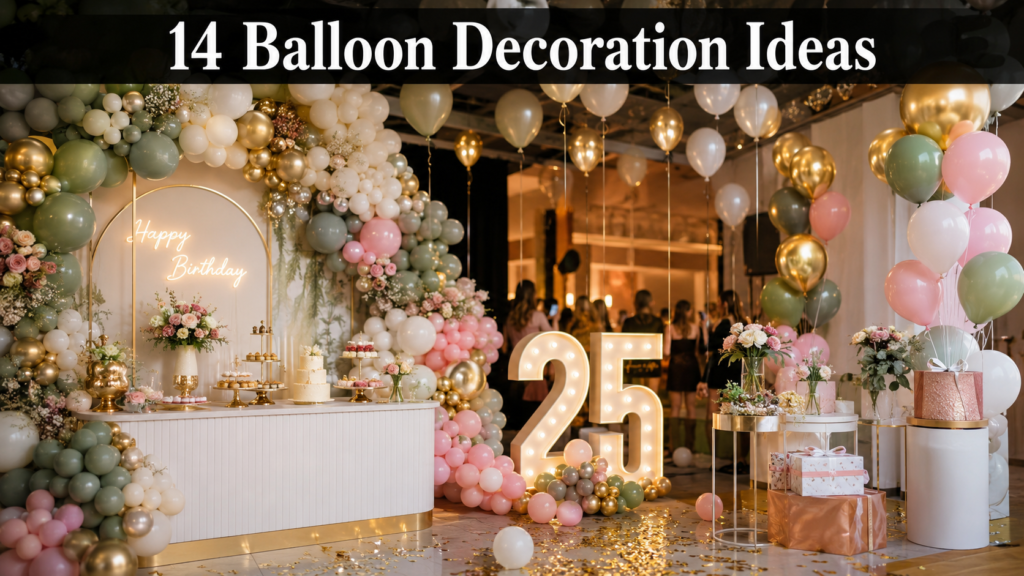
Most people buy balloons, blow them up, tie them to chairs, and call it a day. I did that for my cousin’s birthday three years ago. The balloons drifted into a sad cluster by the ceiling before the first guest arrived, and by cake time, half had deflated into wrinkled little ghosts on the floor.
That experience sent me down a rabbit hole I never expected. I started researching balloon art, tested dozens of setups across family celebrations, school events, and a neighborhood block party, and slowly built a collection of ideas that actually work for real people with real budgets and zero professional training. What I found surprised me: the most stunning balloon displays are rarely the most complicated. They rely on placement, proportion, and one or two techniques done well.
Here is everything I learned, broken into 14 balloon decoration ideas you can pull off without a degree in event planning.
What Makes Balloon Decor Actually Work Before You Buy a Single Balloon
Before jumping into the specific ideas, there is one principle worth understanding: balloon decor works through volume and intentional placement, not through complexity. A single arch done well will outperform twenty random balloon clusters every time.
When I helped plan my neighbor Sara’s daughter’s quinceañera in 2024, the initial budget for decor was tight. We skipped the floral centerpieces entirely and invested in one large organic balloon arch at the entrance and a simple column pair at the cake table. Guests photographed those two elements all night. Total balloon spend: around $85 in supplies. The photos looked like a $500 professional setup.
The lesson matters: choose two or three of the ideas below and execute them well rather than attempting all fourteen at once.
1. How Do You Make an Organic Balloon Garland Without Special Skills?
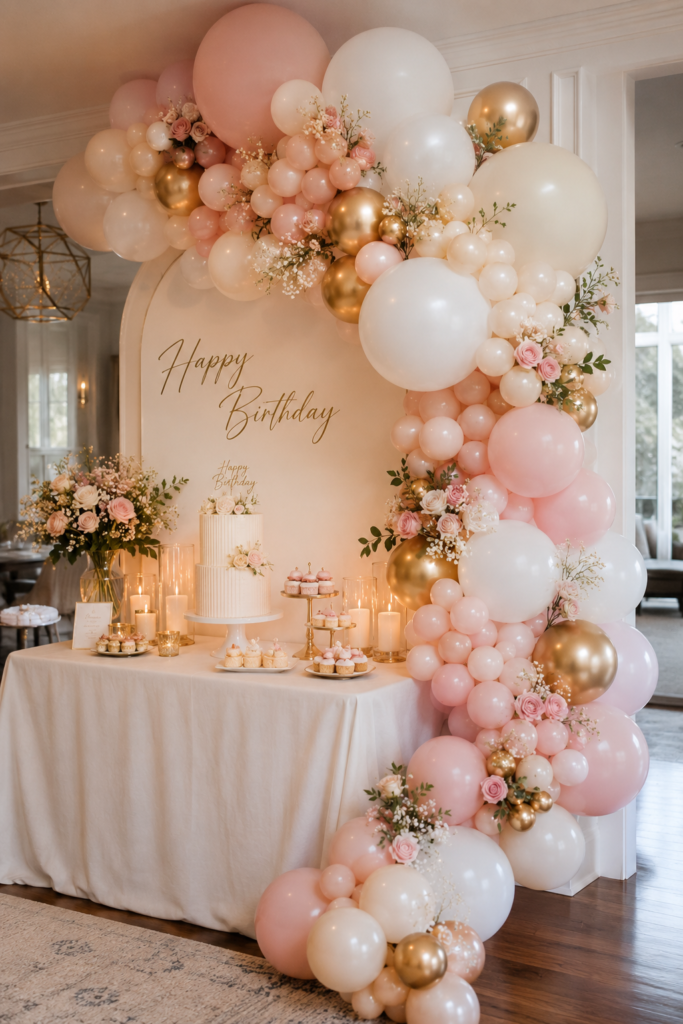
An organic balloon garland is the single highest-impact balloon decoration you can create. It uses balloons in multiple sizes and two to four coordinating colors, attached to a flexible strip or fishing line, and shaped into a flowing, irregular cluster.
The key word is “organic.” Unlike a traditional garland where every balloon is the same size and evenly spaced, an organic garland deliberately mixes 5-inch, 11-inch, and 16-inch balloons. That size variation is what gives it the lush, cloud-like texture you see in professional photos.
How to make one in about two hours:
Start with a balloon decorating strip (available from brands like Qualatex or Betallic for around $4 to $6 per 5-foot strip) or tie balloons directly to a length of fishing line using a simple overhand knot. Inflate your balloons to different sizes intentionally: some fully round, some slightly under-inflated for a softer shape. Attach them in clusters of three, rotating your colors so no two adjacent balloons match. Fill gaps with 5-inch balloons last.
Here is what nobody in beginner tutorials tells you: under-inflating about 30% of your balloons on purpose is the secret to that professional, dimensional look. Fully inflated balloons sit in a flat row. Under-inflated ones nestle between the others and create depth.
A 6-foot garland typically needs 80 to 100 balloons and takes about 90 minutes start to finish.
2. What Is the Easiest Balloon Arch for a Beginner at Home?
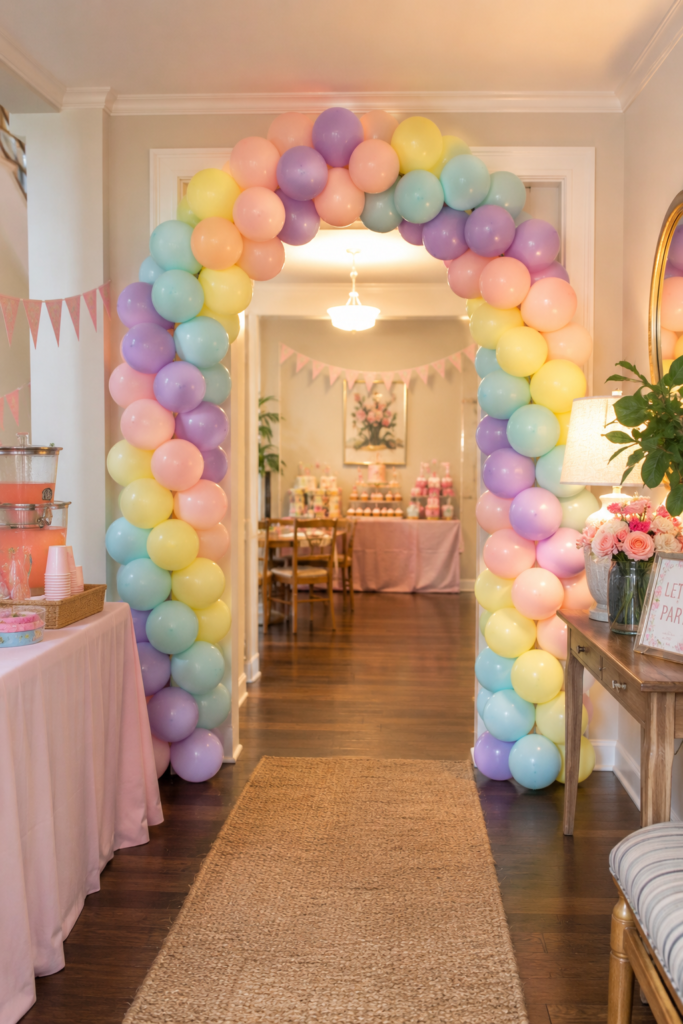
A link-o-loon arch (also called a bubble arch) is the most forgiving arch style for beginners. Instead of attaching balloons to a frame, you use balloons with handles that link directly to each other, forming a self-supporting loop or arch shape.
Link-o-loon balloons from Qualatex retail for roughly $12 to $15 per bag of 50. You will also need two anchor points (chairs, poles, or door frames work fine) and a hand pump. The entire arch links together like a chain, and you can build a 6-foot span in about 30 minutes.
This is genuinely the right starting point if you have never made balloon decor before. It tolerates imperfect inflation, forgives uneven sizing, and can be assembled by one person. Once you feel comfortable with this format, the organic garland becomes much less intimidating.
3. Can You Create a Balloon Backdrop for Photos Without a Professional Frame?

You can, and the setup costs a fraction of what rental frames charge.
The simplest approach uses a tension rod, a wooden dowel suspended between two tall objects, or a freestanding clothing rack. Attach pre-inflated balloons using balloon clips or by tying them directly to the rod with clear fishing line, working from the center outward.
For a photo booth backdrop at my friend Marcus’s graduation party in May 2025, we used a standard tension rod placed in a doorway and covered it with balloon clusters in his school colors. We added a few large foil letter balloons spelling “CLASS OF 2025” across the top. Total time: about 45 minutes. Every single guest used it as a photo spot.
If you want a more substantial backdrop that stands freely, PVC pipe connectors from a hardware store (typically under $20 total) can be assembled into a rectangular frame without any tools. Most online tutorials use 3/4-inch PVC pipe cut to a 6-foot by 4-foot frame. The pipe holds balloon tape beautifully and breaks down for storage.
4. What Are Balloon Columns and When Should You Use Them?
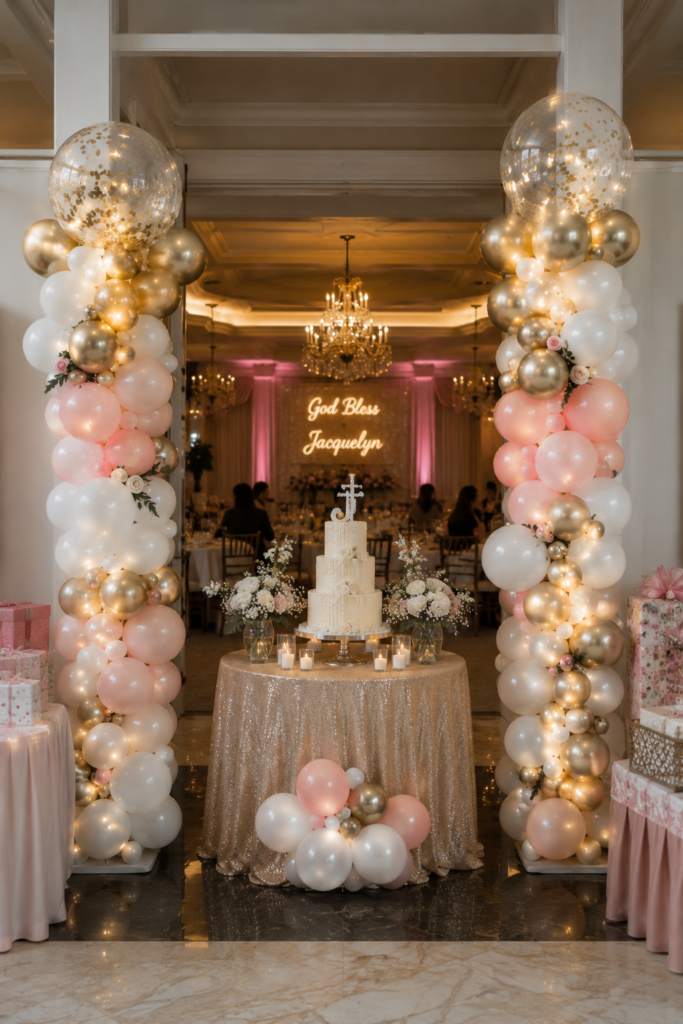
Balloon columns are vertical towers made by stacking groups of four balloons (called a quad cluster) around a central pole, usually a weighted PVC base topped with a helium-free balloon tower.
They work best as anchor points: flanking a stage or presentation area, marking the entrance to a venue, or standing beside a cake or gift table. Two columns create a natural “entrance” visual that draws the eye and signals where the important action is happening.
The honest limitation here: balloon columns require a base weight to stay upright outdoors. I learned this the hard way at a spring outdoor birthday when both columns tipped over within an hour because I underweighted the bases. Inside, a sandbag or bucket of sand (roughly 15 to 20 pounds) handles wind perfectly. Outside with any breeze, you need heavier bases or ground stakes.
5. How Do You Make Balloon Centerpieces That Stay Upright All Day?
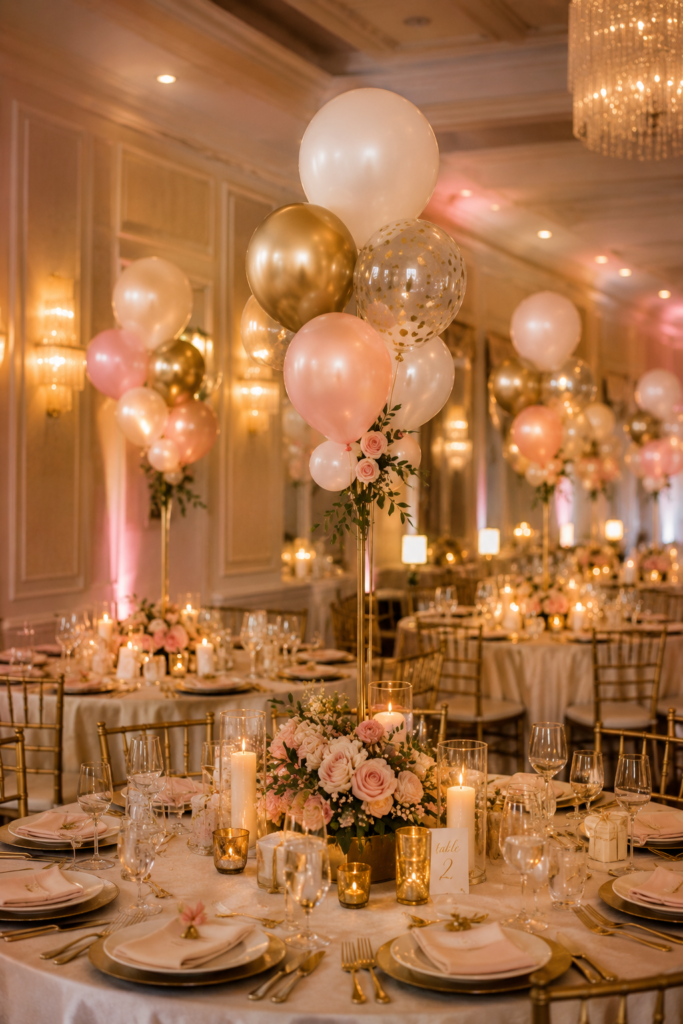
The classic mistake with balloon centerpieces is using helium without a weight heavy enough to anchor them. Helium-filled latex balloons typically float for only 12 to 18 hours at room temperature before they start to droop.
Two approaches consistently work better:
Air-filled centerpieces on sticks: These use a balloon on a curling ribbon or clear balloon cup attached to a stick, weighted with a base. Because they use air instead of helium, they stay fully inflated for days. They sit lower than floating balloons but photograph beautifully and cost almost nothing to make. A 20-pack of balloon cups and sticks runs about $6 on Amazon.
Helium clusters with Hi-Float treatment: If you want floating centerpieces, coat the inside of each balloon with Hi-Float solution ($8 to $12 per bottle, available at party supply stores) before inflating with helium. Hi-Float extends float time from 12 hours to 2 to 3 days. This is what professional balloon decorators use almost universally.
For Sara’s quinceañera, we used air-filled centerpieces on 36-inch sticks with large foil star balloons at the top. They lasted the entire weekend and required no helium at all.
6. What Is a Balloon Ceiling Installation and Is It Hard to Do?
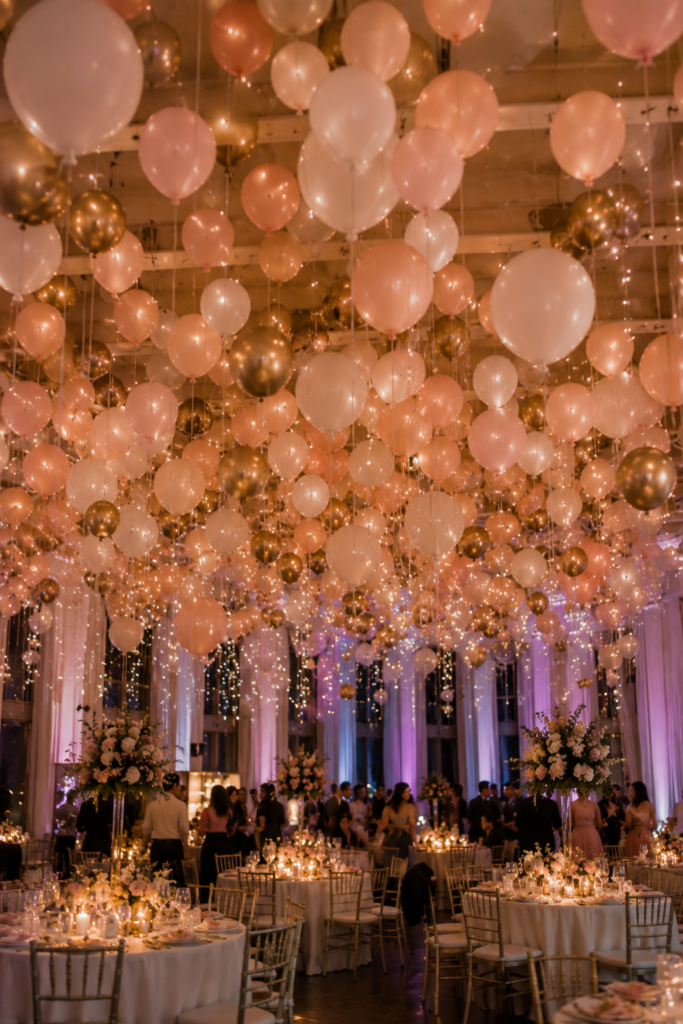
A balloon ceiling installation, sometimes called a balloon drop or ceiling cluster, fills overhead space with balloons that hang at varying heights. The result turns an ordinary room into something that feels intentionally designed.
The simplest version: inflate 11-inch latex balloons with air, tie a length of clear fishing line to each, and tape the other end to the ceiling at different heights between 12 inches and 48 inches. Use at least 40 to 60 balloons for a meaningful effect in a standard dining room.
A more dramatic version, popular for New Year’s Eve and milestone birthdays, uses a net or bag filled with hundreds of uninflated balloons that drop on a timed release. Pre-built balloon drop bags from Pioneer Balloon Company allow you to load up to 500 balloons and release them with a simple pull cord. These run $15 to $25 for the bag itself.
The ceiling cluster approach (non-drop) works better for events that last several hours because drop bags are a one-time use moment.
7. How Can You Use Balloon Stuffing to Create Unique Displays?
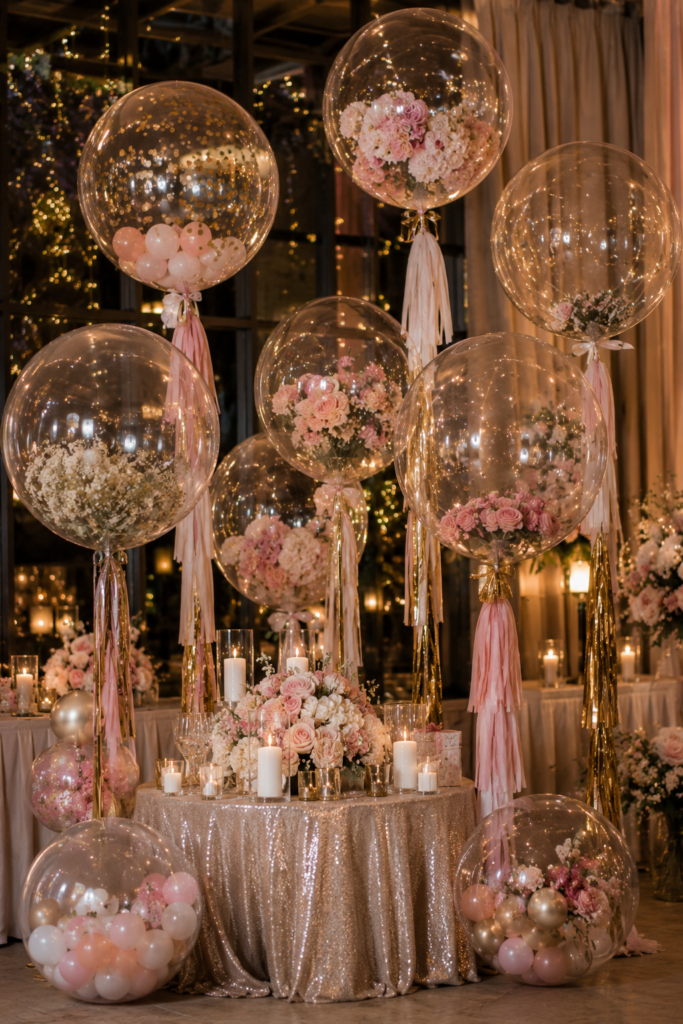
Stuffed balloons are a genuinely underused technique. Using a balloon stuffing machine (the Qualatex Stuffer retails for about $40 to $50), you can place small objects, flowers, confetti, or smaller balloons inside a large clear balloon before inflating it.
The effect is striking: clear 24-inch balloons filled with rose petals, gold confetti, or mini balloons in contrasting colors look like expensive display pieces. Brands like Betallic sell “bubble balloons” specifically designed for this—they are made from a clearer, stretchier material than standard latex that shows the interior contents beautifully.
At a Valentine’s Day tablescape I helped create, we stuffed 18-inch clear balloons with dried lavender and a single small message card. Guests kept asking where we had ordered them. The actual cost per balloon was under $2.
8. What Is a Balloon Wall and How Big Should It Be?
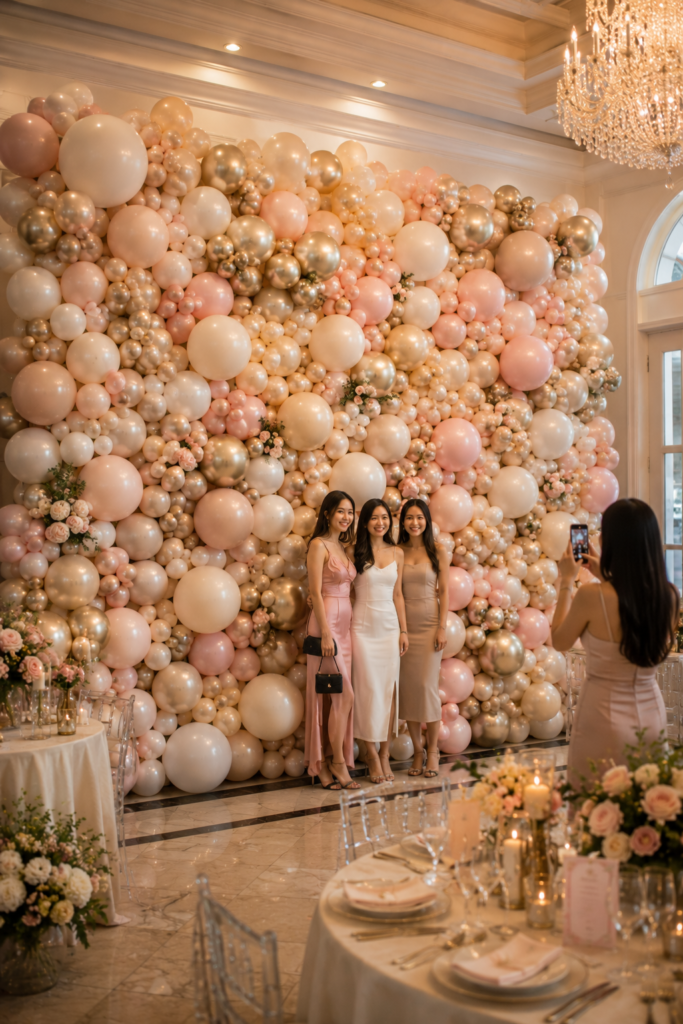
A balloon wall is exactly what it sounds like: a wall surface completely covered with balloons, often arranged in a pattern or gradient of colors. It creates one of the most photographed backdrops at any event.
For a grid-pattern balloon wall (the most structured look), you attach inflated balloons to a pegboard or chicken wire panel. For an organic balloon wall (softer, more popular currently), you attach balloons in clusters directly to a structure using balloon tape or tie them to a mesh backing.
Size matters here. A balloon wall smaller than 6 feet wide and 5 feet tall tends to look like a backdrop that ran out of budget mid-build. If you commit to this idea, commit to the full size. For reference, a 6 by 6-foot wall requires approximately 150 to 200 standard 11-inch balloons depending on how tightly packed you want the coverage.
The most important tool for this project: a cheap electric balloon pump. Inflating 200 balloons by mouth will take the enjoyment out of any party prep. The AGPTEK electric pump runs about $15 to $20 and handles standard latex balloons reliably.
9. How Do You Decorate with Balloon Numbers or Letters for Milestones?
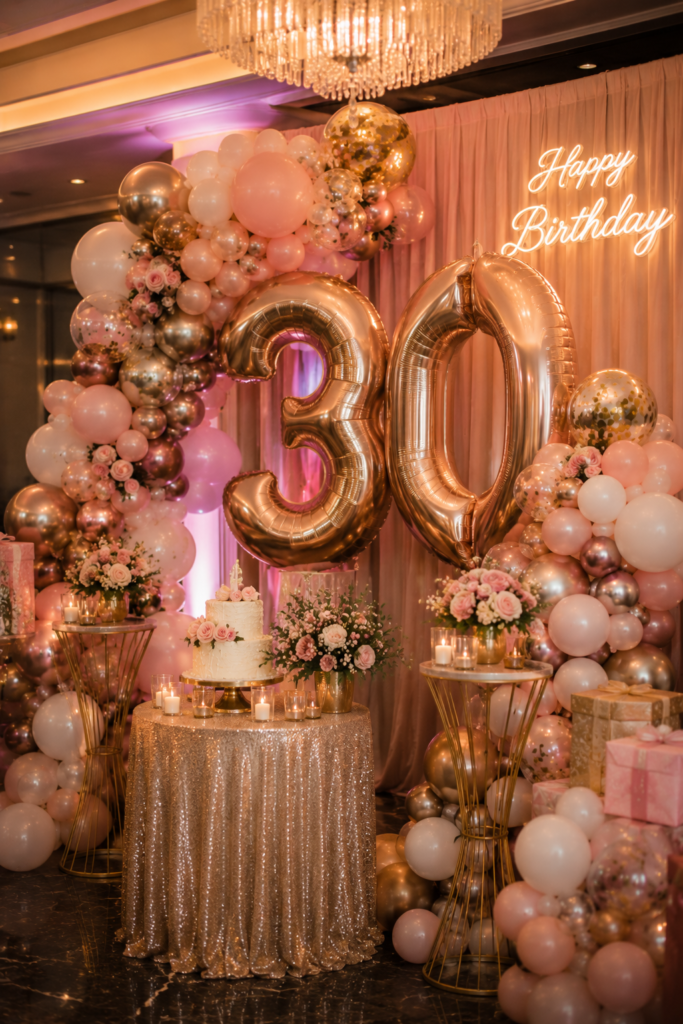
Large foil number and letter balloons (sold in 40-inch sizes) have become one of the most requested elements for milestone celebrations. They work because they communicate instantly: “40th Birthday,” “BRIDE,” “BABY” — no explanation needed.
The technique most people get wrong: placing them on the floor without support. Foil balloons filled with helium float; filled with air and placed on the floor, they lean over within minutes. The right approach is to use balloon weights (filled bags specifically designed to anchor balloons) or to affix them to a pipe and drape backdrop structure.
A popular 2025 trend pairs giant number balloons with an organic balloon garland around or behind them. The foil provides the clear message; the garland provides the visual texture. Together, they create a cohesive focal point that reads well in photos even from across the room.
10. What Are Balloon Bouquets and How Many Do You Need for a Party?
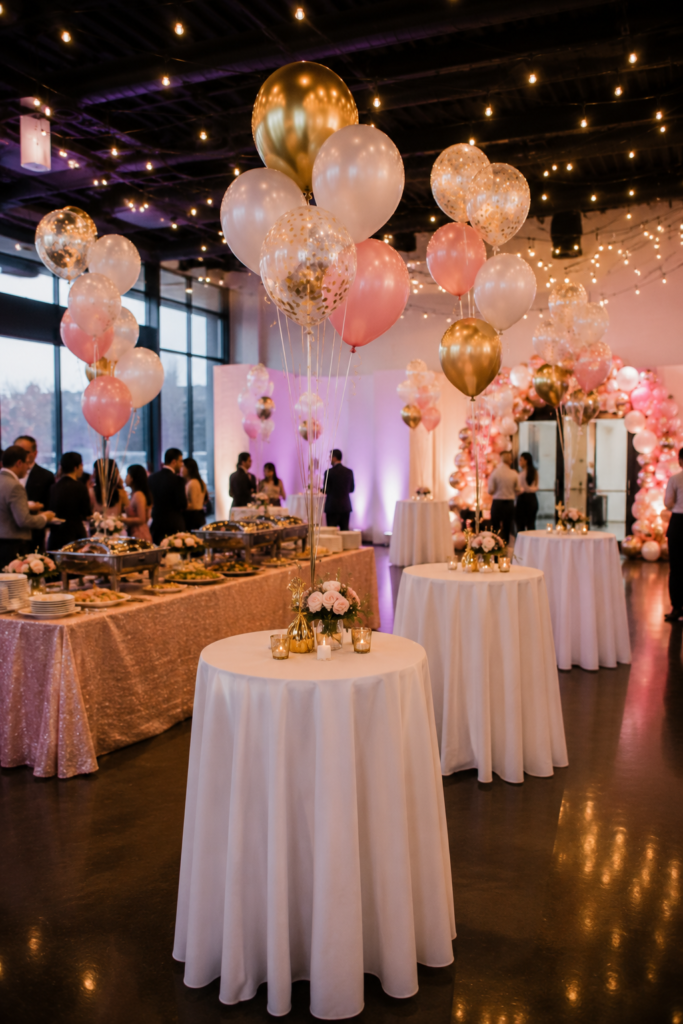
A balloon bouquet groups multiple balloons together — typically five to seven balloons of varying heights, tied to a weight. They are the most versatile balloon decoration because they work at any scale and can be placed virtually anywhere.
The rule I follow for room coverage: one bouquet per table for seated events, and one per every 8 to 10 linear feet of open space for standing events. For a 30-person seated dinner, that means roughly six to eight bouquets. For a 30-person backyard party, plan for four to six bouquets placed strategically at the bar, food table, entrance, and one or two open areas.
Bouquet placement is more important than quantity. A single well-placed bouquet at an entrance creates more visual impact than three bouquets clustered in a corner where foot traffic never reaches.
11. How Can You Use Balloons Outdoors Without Everything Blowing Away?
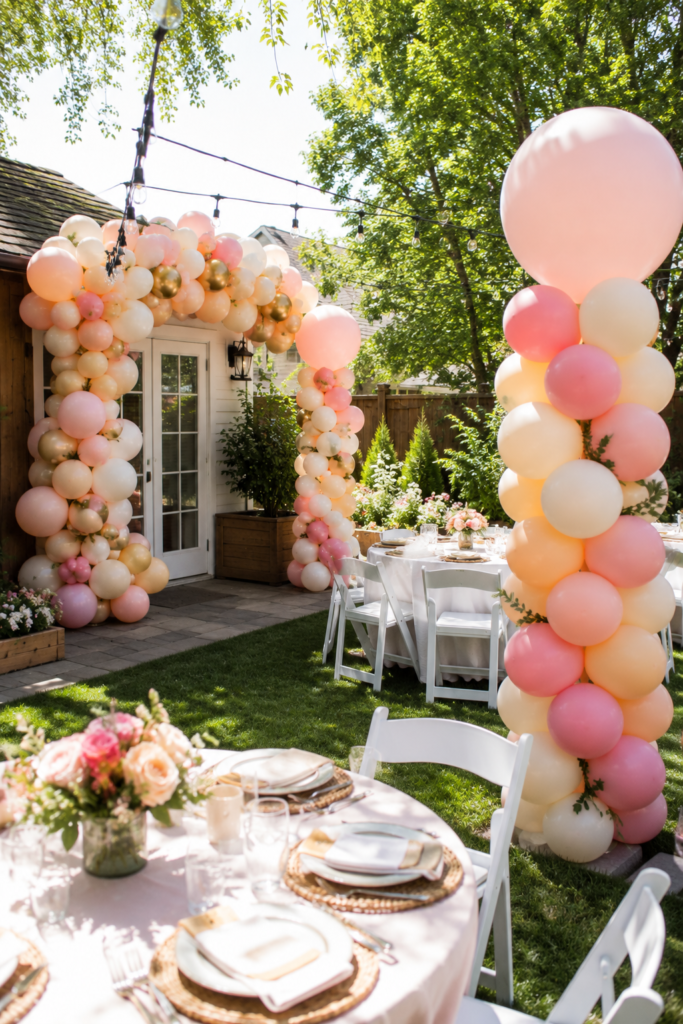
Outdoor balloon decor requires a different approach than indoor. Three things consistently cause outdoor balloon failures: wind, heat, and inadequate anchoring.
For wind, stick to air-filled balloons over helium outdoors whenever possible. Air-filled balloons on sticks, columns, and garlands are dramatically less affected by wind than floating helium clusters. When you need floating balloons outside, use pearl-finish latex rather than standard latex; they handle temperature changes slightly better.
For heat: latex balloons expand in heat. If you inflate to full capacity indoors and move them outside in summer, expect some to pop. Inflate outdoor balloons to about 80% capacity in the summer months to give them expansion room.
For anchoring, the most reliable outdoor weights are water-filled buckets concealed under table linens, concrete landscape blocks hidden by decorative elements, or balloon weights filled with enough sand to hold against a 20 mph breeze (you need about two pounds per floating balloon cluster).
12. What Are Some Creative Balloon Decor Ideas for Kids’ Birthday Parties?
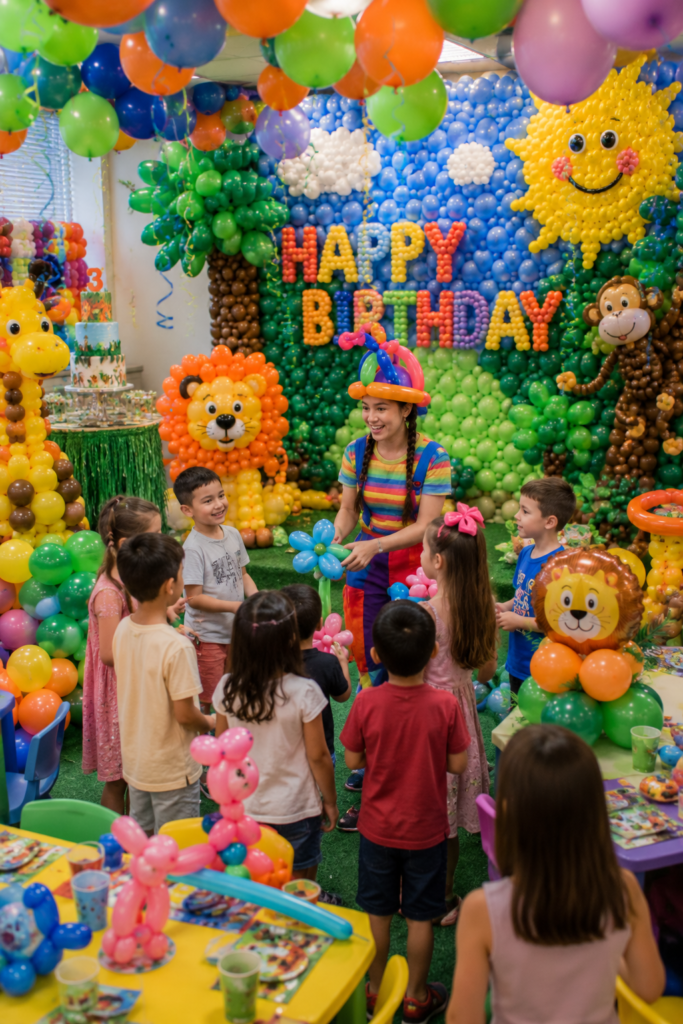
Kids’ parties benefit from interactive balloon elements — not just decoration, but something they can engage with.
Three ideas that consistently land well:
Balloon mosaic photo frames: Large block letters or shapes (a star, a number, a crown) built from balloons that children can stand inside or in front of for photos. These use the same balloon wall technique but in a shaped panel.
Balloon animal bouquets: Mixed into a standard bouquet, one or two twisted balloon animals (made with 260-inch modeling balloons) add a playful element kids actually notice and love. Simple animals like dogs, swords, or butterflies can be learned from basic tutorials in about an hour of practice.
Balloon drop countdown: Instead of a standard reveal moment, a balloon drop timed to coincide with the birthday song creates a memorable sensory experience children talk about afterward.
For modeling balloons, Sempertex 260s are the professional’s choice, retailing for about $8 to $10 per bag of 100 in solid colors.
13. How Do Balloon Garlands Work for Baby Showers and Gender Reveals?
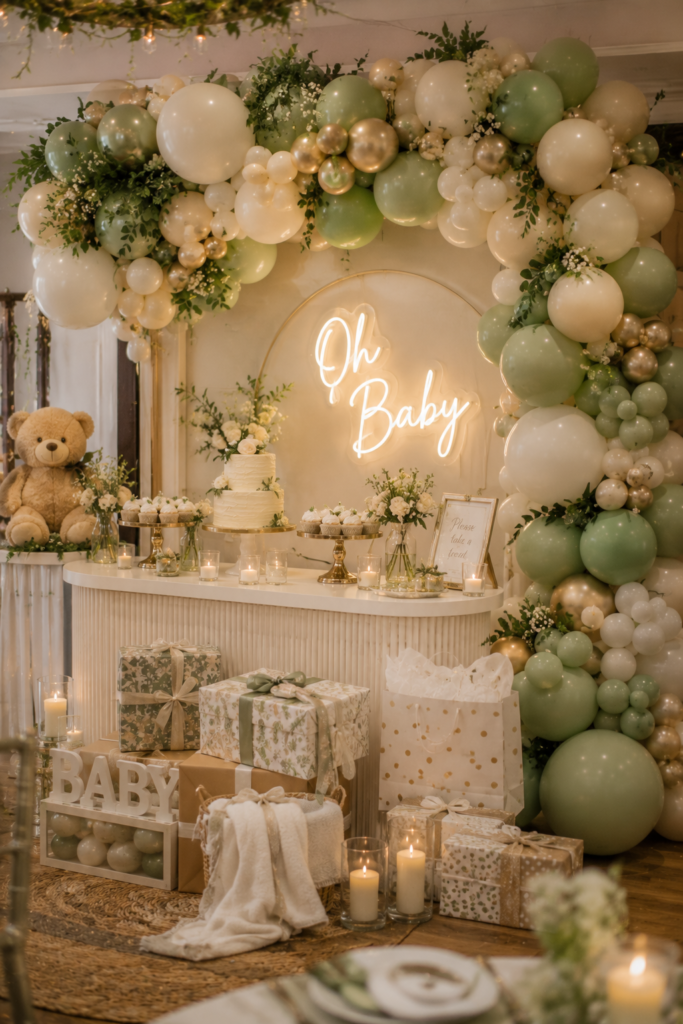
Baby showers and gender reveals have driven some of the most creative balloon decor innovation in recent years. The organic balloon garland, in particular, has become a signature element because it photographs beautifully and can be customized to any color palette.
For gender reveals, the balloon color choice obviously communicates the reveal. A popular current approach: a large white balloon or box that, when popped or opened, releases smaller balloons in pink or blue along with confetti. The outer balloon is made from white latex; the reveal balloons inside are uninflated until the moment of pop, when they are released by air pressure and the confetti puffs out.
For baby showers, sage green and terracotta have replaced the traditional pink-and-blue palette in many 2025 celebrations. Neutral palettes with white, cream, and one muted accent color photograph exceptionally well and feel more timeless. Sempertex and Qualatex both offer expanded earth tone ranges now that make these palettes easy to source.
14. What Is the Most Budget-Friendly Balloon Decoration for a Large Event?
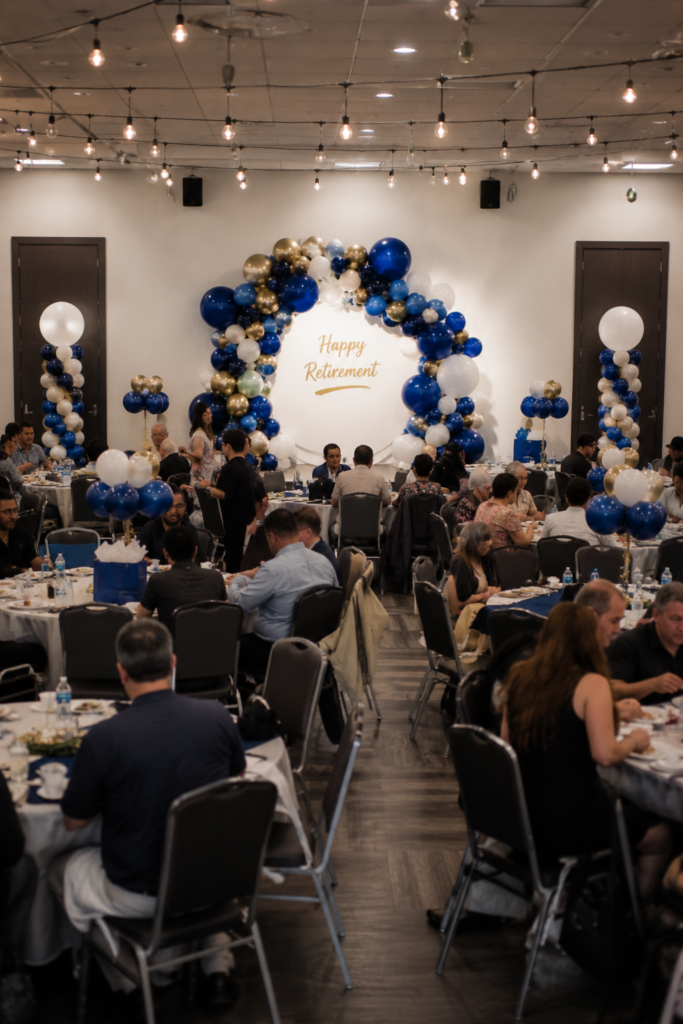
Here is the honest answer most party planning blogs avoid: for large events on tight budgets, balloon arches and columns give you the highest visual return per dollar spent compared to any other decoration category.
A single 10-foot organic balloon arch typically costs $40 to $70 in supplies if you make it yourself. A professionally installed equivalent runs $200 to $400. The technique is learnable in one afternoon.
For events over 50 people, I recommend this approach: one large focal piece (arch or wall) placed at the primary photo location, and simple balloon clusters in matching colors placed at key functional spots (bar, entrance, food area). Skip even coverage across the whole room. Nobody photographs the middle of a room. They photograph the bar, the dessert table, and the entrance.
My lowest-cost large event decor: a community fundraiser for 120 guests in 2024. Total balloon budget was $60. We built one large organic garland at the donation table (the focal point of the event), two simple columns at the entrance, and used a bag of 50 9-inch balloons tied in clusters of three at the bar and food tables. Multiple guests asked which decorator we had hired.
Frequently Asked Questions About Balloon Decorations
How far in advance can I make balloon decorations? Air-filled latex balloon decorations can be made 24 to 48 hours in advance if stored in a cool, dry indoor space away from sunlight. Foil balloons last much longer (several days to weeks air-filled). Helium-filled latex should be inflated no more than 8 to 12 hours before the event unless you use Hi-Float treatment.
What is the best balloon brand for DIY decorations? Qualatex and Sempertex are the two professional standards. Both offer consistent sizing, better latex quality, and a wider color range than generic brands. Generic balloons from dollar stores pop more frequently and size unevenly, which makes garlands and arches look messy. The price difference is small: about $8 to $12 for 50 balloons from a professional brand versus $2 to $4 for 50 generic balloons. The quality difference is significant.
How do you keep balloons from popping at parties? Keep balloons away from rough surfaces, direct sunlight, and heat sources. Avoid over-inflating: most 11-inch balloons should be inflated to a diameter of about 10 inches to leave some expansion room. Use pearl or metallic finish balloons at outdoor summer events since they reflect heat better than standard latex.
Can you reuse balloon decorations? Foil balloons can be carefully deflated, stored flat, and reinflated multiple times. Latex balloons are single-use. Balloon strips, clips, and fishing line can be reused indefinitely. Building a small kit of reusable hardware (clips, strips, fishing line, weights, and a pump) makes future decoration projects significantly cheaper.
What do you do with balloons after the event? Latex balloons should be deflated and disposed of in household waste, not released outdoors (balloon releases have been banned in many municipalities due to environmental impact). Foil balloons should be deflated and recycled where facilities exist. Many party stores now accept foil balloons for recycling.
How many balloons do I need for a 10-foot arch? A standard 10-foot organic balloon arch using 11-inch balloons needs approximately 120 to 150 balloons depending on how full you want the coverage. Add another 20 to 30 small (5-inch) balloons to fill gaps and add depth.
The Honest Takeaway
Balloon decoration has a reputation for being either impossibly complex or embarrassingly basic. Neither is true when you understand a few core techniques.
The organic garland changed what I thought was possible with balloons. The link-o-loon arch removed the fear that you needed professional equipment. Stuffed balloons made me realize how much texture and creativity you can pack into a single display element. And the outdoor anchoring lessons I learned through failure saved more than one event from looking like a mess.
If you are starting from zero, build one organic garland for a low-stakes event first. Get comfortable with the sizing, the attachment technique, and the color mixing. Once that clicks, every other idea on this list becomes much more approachable.
Which of these 14 ideas are you planning to try first? And if you have a balloon decoration method that consistently works for you, I would genuinely like to know what it is.